Category: Uncategorized

  • How Much Weight a Pizza Box Really Holds: ECT, Stacking, and Storage

    How Much Weight a Pizza Box Really Holds: ECT, Stacking, and Storage

    There are two strength questions buyers ask about a pizza box, and they are not the same question. One is how much a single box can hold, which matters when a loaded pie sits at the bottom of a delivery bag. The other is how much weight the box can carry stacked on top of it, which matters when a tower of flat stock sits in a back room or a bag holds three or four orders at once. People shop for the first number and then get surprised by the second. Understanding both, and the small formula that connects them, is what keeps a stack from pancaking on a Friday night.

    ECT is the number on the box, and it means less than you think

    ECT stands for edge crush test, and it measures how much force the board resists when pressed on its edge, reported in pounds per inch. It is the modern way corrugated is graded, and it is what most suppliers quote. Single-wall board runs across a familiar ladder of grades, and each grade carries a rough guide to how much weight a single box is rated to hold. The most common specification you will meet, by a wide margin, is 32 ECT, often paired with the older 200-pound Mullen burst rating. For a standard pizza box that is usually plenty, which is exactly why it is the default.
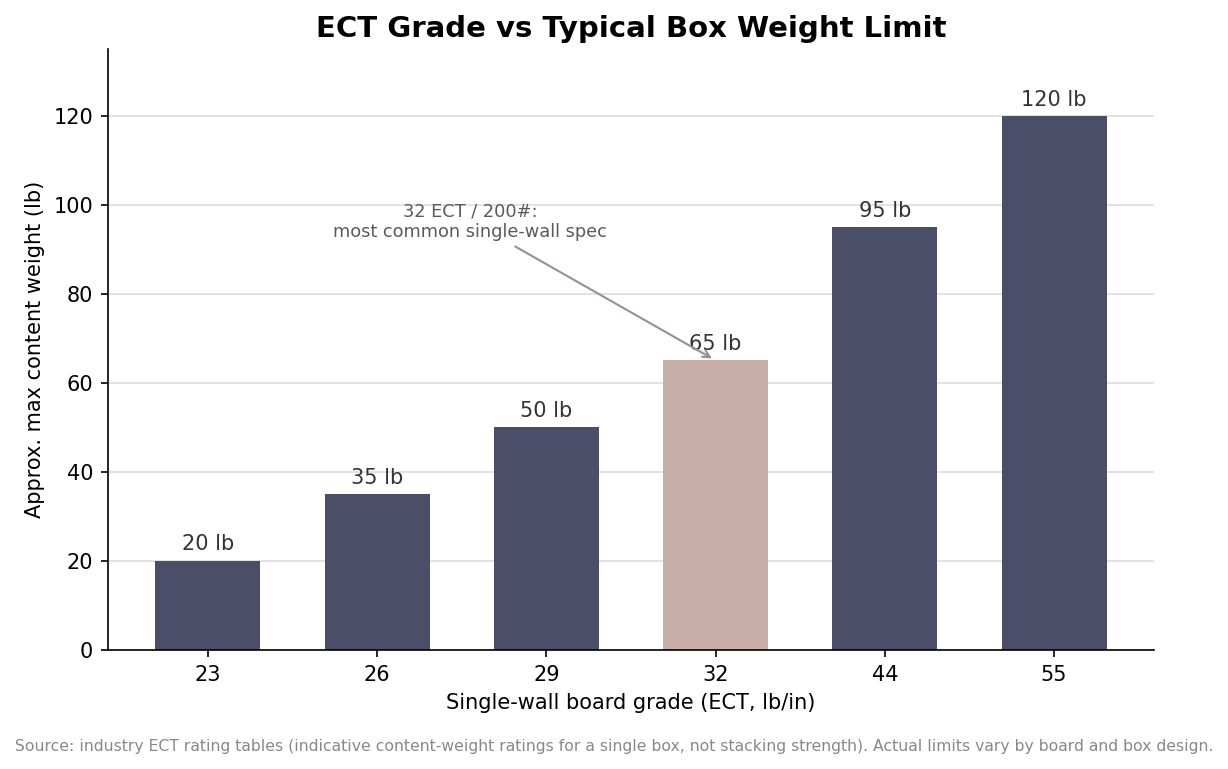
    Bar chart of single-wall ECT grades and typical box weight limits: 23 ECT 20lb up to 55 ECT 120lb, with 32 ECT (65lb) marked as the most common spec
    Indicative single-box content-weight ratings by ECT grade; 32 ECT is the standard pizza-box specification.

    The important caveat is what that ladder does and does not tell you. Those figures are indicative content-weight ratings for one box sitting by itself, and they vary with board and box design. They are a useful sanity check when you are choosing a grade, but they say nothing directly about what happens when you stack boxes on top of each other. For that you need a different calculation, and it is the one that actually governs a storage room or a delivery bag.

    Stacking strength is a different calculation

    The load a box can bear from above before it buckles is its box compression strength, and you can estimate it from ECT with the McKee formula. The short version is BCT equals 5.87 times the ECT value, times the square root of the box perimeter multiplied by the board caliper, with everything in inches and pounds. Perimeter is just twice the length plus the width, and caliper is the board thickness. Run it for a typical 16-inch pizza box in 32 ECT B-flute, with a 64-inch perimeter and a caliper around an eighth of an inch, and you land near 530 pounds of estimated compression strength for the box as a whole.
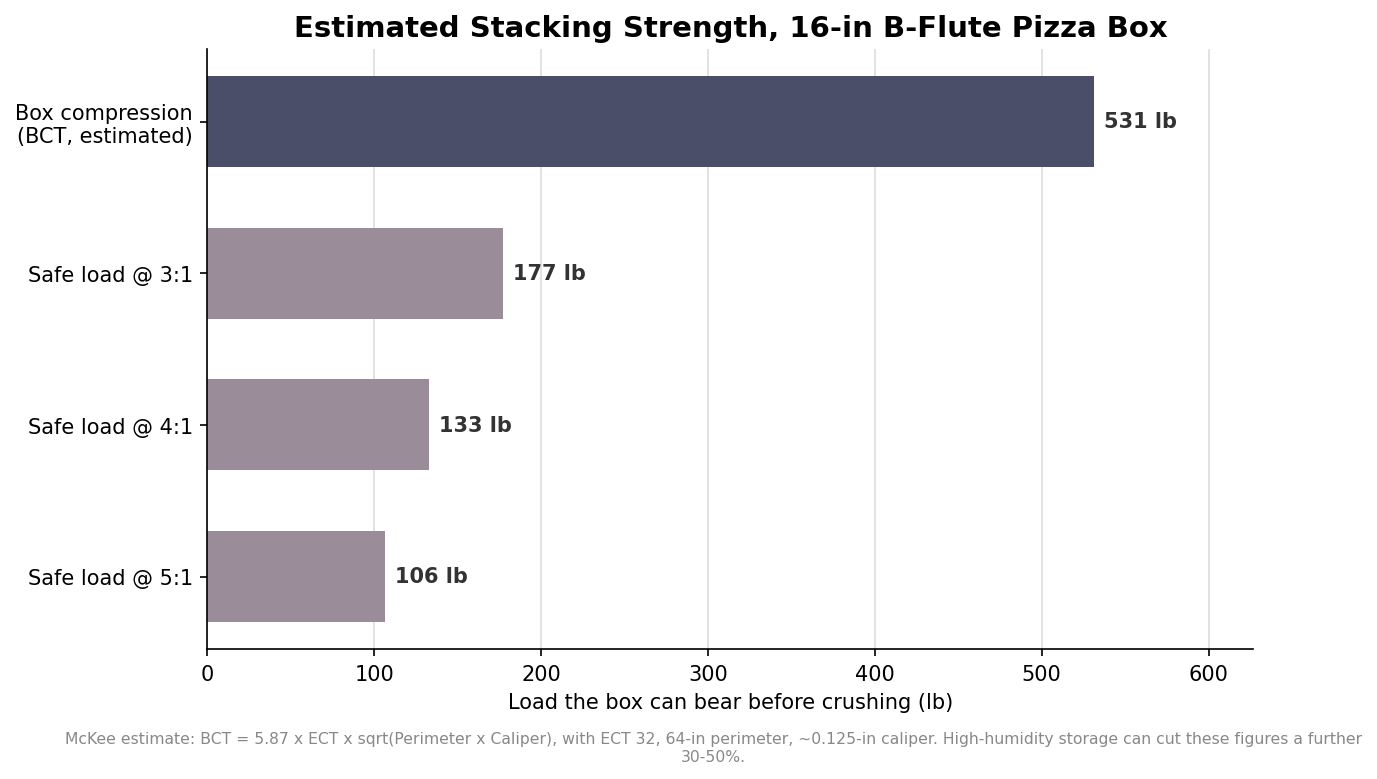
    Horizontal bar chart estimating a 16-inch B-flute pizza box compression strength at about 531 lb, with safe loads of 177, 133, and 106 lb at 3:1, 4:1, and 5:1 safety factors
    A McKee estimate for a 16-inch box: the raw compression ceiling versus safe working loads after a safety factor.

    That number sounds enormous next to a two-pound pizza, and it is, but it is also the ceiling right before failure rather than a working limit. The formula also explains a detail that trips people up: a smaller, thicker box is stronger than a large, thin one made from identical board, because both perimeter and caliper feed the result. It is why a 16-inch box and a 20-inch box in the same grade do not carry the same load, and why upsizing a box without upgrading the board can quietly cost you strength.

    Why you divide that number by three to five

    Nobody loads a box to its breaking point, so engineers apply a safety factor, typically between three to one and five to one, to the compression figure. Divide that estimated 530-pound ceiling by three and you get a safe working load around 177 pounds; divide by five for long or rough storage and it drops to about 106. The heavier factors account for the fact that real life is not a laboratory. Boxes get handled, dropped, and stacked unevenly, and a static press test does not capture the jolt of a delivery bag hitting a car seat. The rule of thumb is simple: the longer boxes sit under load and the rougher the handling, the closer to five to one you should plan.

    Humidity and time quietly steal the rest

    Corrugated is paper, and paper gives up strength to moisture. Board stored in high-humidity conditions can lose 30 to 50 percent of its compression strength, which turns that comfortable safe load into a much thinner margin. A pizza kitchen is one of the more hostile environments for it: steam, wash-down areas, and boxes stored near a damp floor all pull the numbers down. Heat and grease from the pie itself soften the bottom of a loaded box the same way. This is the hidden reason a stack that looked solid at delivery time sags by the time it reaches the customer, and why the same box performs differently in a dry warehouse than in a humid back room.

    The fixes are ordinary warehouse discipline. Keep flat stock off concrete on a pallet or shelf, away from exterior walls and dish areas, and rotate older stock so it is not absorbing moisture for months before use. Do not build flat-stock towers taller than they need to be, because the boxes at the bottom carry the whole column and are the first to crush once humidity has done its work. If your storage is genuinely damp, plan your grade as though you have already lost a third of the rated strength, because you probably have.

    What this means when you spec and store

    For most pizzerias, 32 ECT single-wall is the right starting point, and the strength conversation only becomes urgent when you stack tall or store in a humid space. If you regularly bag three or four loaded pies together, or keep deep towers of flat stock, it is worth asking your supplier for the BCT of the specific box rather than trusting the grade alone, and planning to a four-to-one or five-to-one safety factor with the humidity haircut on top. Flute choice plays into this too, but the practical levers are the grade you order, the size you order it in, and where you keep it. Get those three right and the box does its quiet job: holding the pie flat, holding its neighbors up, and never becoming the reason an order arrives crushed.
  • How to Spec a Pizza Box That Won’t Deliver a Soggy Pie

    How to Spec a Pizza Box That Won’t Deliver a Soggy Pie

    A soggy delivery pizza is almost always blamed on the kitchen, but a large share of the damage happens inside the box on the way to the door. The pie leaves the oven crisp and arrives limp because the container it travels in traps the one thing that ruins texture: steam. The good news for anyone ordering custom pizza boxes is that this is a specifiable problem. Ventilation, board choice, and a couple of liner decisions are things you write into an order, not things you leave to chance. This walkthrough shows how to spec a box that protects crust texture for the delivery times you actually run.

    The physics: steam is the enemy, not heat

    When a hot pizza sits in a sealed box, water evaporating from the dough, sauce, and cheese has nowhere to go. It condenses on the underside of the lid and on the board beneath the crust, and that trapped moisture is what turns a crisp base to cardboard. Two processes stack on top of each other. Moisture migrates outward from the soft crumb toward the crust, erasing the crispy exterior, while the starches in the dough undergo retrogradation as they cool, recrystallizing into a tougher, staler texture. You cannot stop the pizza from cooling, but you can give the steam an exit before it condenses back onto the food.

    This is why the single most effective kitchen habit costs nothing: let the pizza rest on an elevated rack for roughly 30 to 60 seconds before it goes in the box, so the first hard burst of steam escapes into the room instead of into the packaging. The box then only has to manage the slower moisture that follows. Everything below is about designing the box to do exactly that job.

    Vents: how many, how big, and where they go

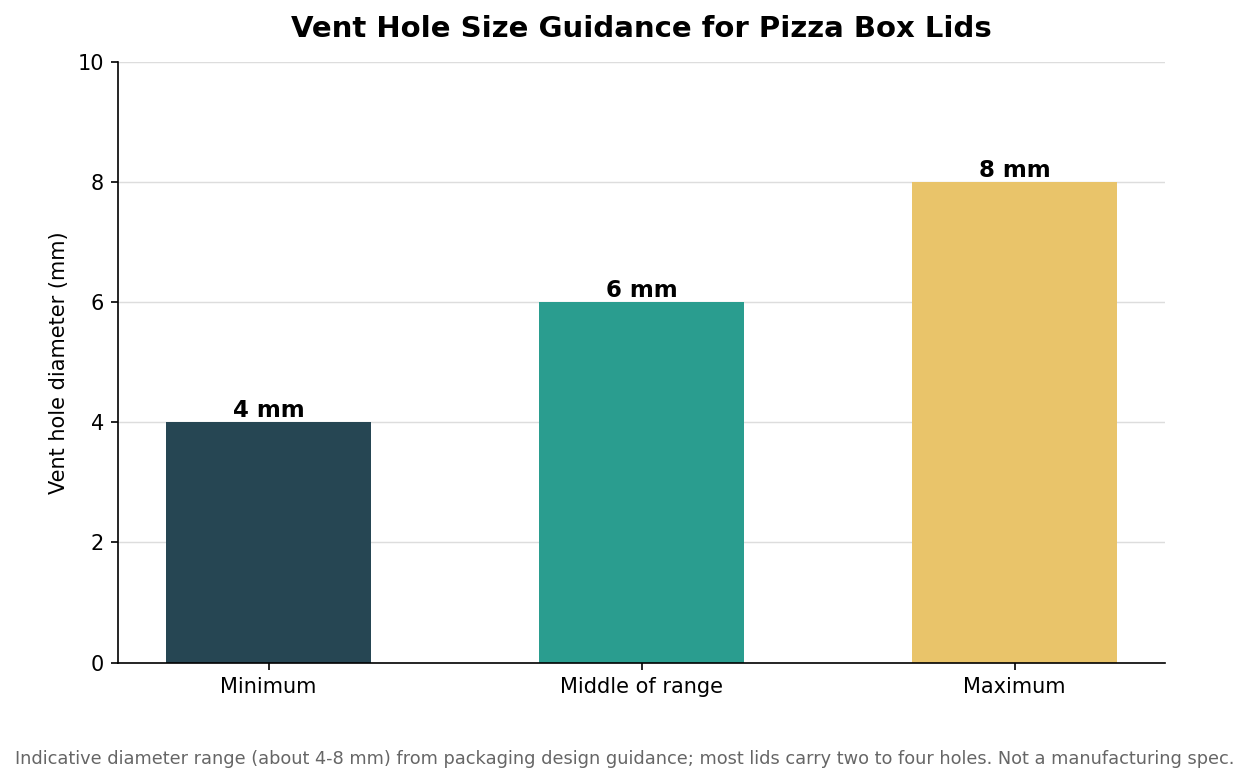
    Ventilation holes are the primary tool, and the useful range is narrower than people assume. Design guidance clusters around two to four round holes, each roughly 4 to 8 millimeters across, placed on the lid or upper side panels. Too few and the steam stays trapped; too many or too large and you bleed off the convective heat that keeps the pizza warm, trading a crisp cold pizza for a soggy problem you did not fix. Placement matters as much as count: vents belong away from the center of the lid so rising steam exits at the edges rather than collecting directly over the pie and dripping back down.

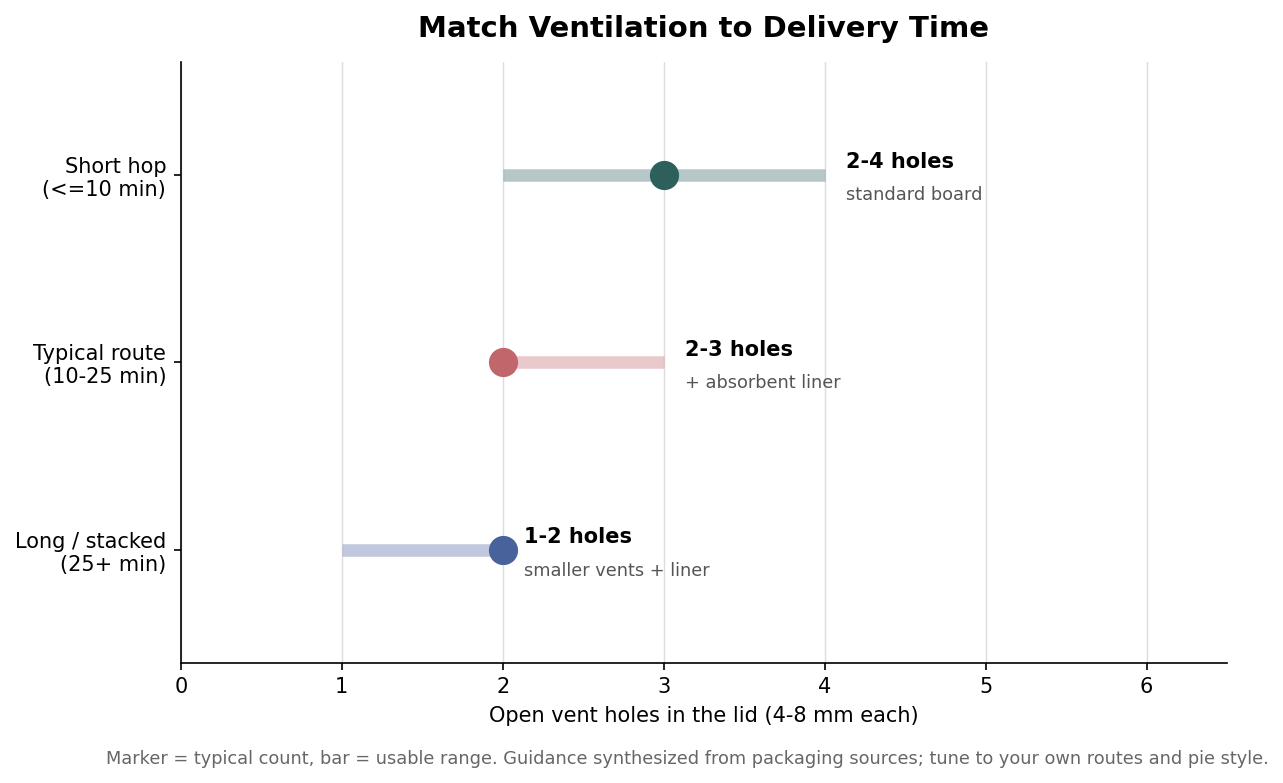
    Dot plot showing recommended number of open vent holes in a pizza box lid by delivery time band, with ranges and liner recommendations
    Recommended open vents by delivery time: fewer, smaller vents plus a liner as routes get longer.

    Corner cut-outs are sometimes used as vents, but they weaken stacking strength, which is a real cost for any operation that towers boxes on a delivery rack or a warmer shelf. Perforated slits that a staff member can pop open after boxing are a flexible middle ground: closed for stacking strength, opened when the box is loaded. Whatever pattern you choose, keep the vents clear of your primary branding zone so a logo or artwork panel never seals a hole shut.

    Board, coating, and liners

    The board itself is your second lever. A stiff, food-safe corrugated stock holds its shape under the combined assault of steam and grease, where a thin caliper box goes soft and sags into the pizza. Grease resistance is a separate property from moisture venting and both matter: a grease-resistant coating or liner stops oil from wicking into the flutes and weakening the board, a topic we cover in depth in our piece on grease-resistant pizza boxes. Vent for steam, coat for oil, and do not assume one solves the other.

    For longer trips, an absorbent liner or a ribbed insert earns its place. A textured liner lifts the crust a few millimeters off the flat board and creates channels for steam to travel sideways and out, instead of pooling directly under the base. On a short hop this is overkill, but past the ten-minute mark it is often the difference between an acceptable base and a wet one. Match the amount of moisture management to how long the food will actually sit in the box.

    Bar chart of indicative pizza box vent hole diameter guidance at 4, 6 and 8 millimeters
    Vent holes typically fall in a 4 to 8 millimeter range, with two to four per lid.

    Match the box to your delivery time

    There is no universal best pizza box, only the right box for a given delivery window. For short routes of about ten minutes or less, two to four standard vents on a stiff coated board handle the moisture without shedding much heat. For the typical ten-to-twenty-five-minute route, keep the vent count modest and add an absorbent liner so the slower steam has somewhere to go. For long routes beyond twenty-five minutes, or when boxes are stacked and cannot breathe freely, lean on smaller vents plus a liner rather than large openings, because at that duration heat retention and moisture control both matter and big holes cost you too much warmth.

    If your menu spans dine-in takeaway and long-distance delivery, it can be worth specifying two box builds rather than forcing one design to cover every case. The incremental cost of a second stock-keeping unit is usually small next to the reputational cost of a signature pie arriving soft.

    Specifying it on your order

    When you brief a printer, translate all of the above into concrete instructions rather than adjectives. State the vent pattern you want, the count and approximate diameter, and confirm the holes fall outside your artwork panels. Name the board grade and caliper, and specify grease resistance as a coating or liner rather than assuming it is included. If you use a ribbed insert or absorbent liner, list it as a line item so it is not quietly dropped to hit a price target. Finally, ask for a physical sample or a dieline proof before a full run, and if you can, do a real-world test: box a hot pizza, drive your longest normal route, and open it at the door the way a customer would.

    None of these choices are exotic, and none of them require premium spending. They require deciding, on purpose, that crust texture is part of your product and specifying the box to protect it. Get the venting, the board, and the liner matched to your delivery times, and the packaging stops being the weak link between a great oven and a happy customer. For a full run-through of everything else that goes on the order, our step-by-step ordering checklist walks through the rest of the spec.

  • Pizza Box Sizes: A Dimension-by-Dimension Chart for Getting the Fit Right

    Pizza Box Sizes: A Dimension-by-Dimension Chart for Getting the Fit Right

    Most people shopping for pizza boxes start with a word: small, medium, large. The trouble is that those words mean different things from one supplier to the next, and a box ordered by adjective has a way of arriving too shallow for the crust or a half inch too wide for the pie. The reliable approach is to order by dimension. Once you know the outer footprint, the interior depth, and how much clearance the pizza actually needs, choosing a size stops being guesswork and becomes a two-number decision.

    This guide lays out the standard sizes side by side, explains why depth is a separate choice from diameter, and covers the small tolerances that decide whether a pizza travels flat or arrives with the toppings shoved into one corner.

    Order by the number, not by the name

    A pizza box is described by a single nominal figure that matches the pizza diameter it is built to carry. A 16-inch box is sized for a 16-inch pizza, a 12-inch box for a 12-inch pizza, and so on. That figure refers to the outer footprint of the box, measured across one side. Because corrugated board has real thickness, the usable interior runs roughly a quarter inch smaller than the nominal size on each side, so a box labeled 16 inches gives you a little under 16 inches of clear floor. That is deliberate, and it matters more than it looks, as the clearance section below explains.

    Regional naming is the reason to distrust adjectives. One shop’s large is another’s medium, and “family size” is not a measurement at all. When you specify a custom run, give the outer length, width, and height in inches. It removes ambiguity from the quote and from the artwork, since the printable panel dimensions follow directly from the box size.

    The standard pizza box size chart

    The sizes below are the common industry footprints. Personal boxes run about 7 by 7 inches or 9 by 10 inches for a single-serve or two-slice pie. The everyday retail range covers 10, 12, 14, 16, and 18 inches square, and extra-large formats reach 20 by 20 or 24 by 24 inches for party pies. A 10-inch box is typically around 10 by 10 by 1.5 inches, a 12-inch box about 12 by 12 by 1.75 inches, a 14-inch box 14 by 14 by 1.75 inches, and 16- and 18-inch boxes about 2 inches deep. Treat those heights as the default for standard crusts; deeper styles are covered next.

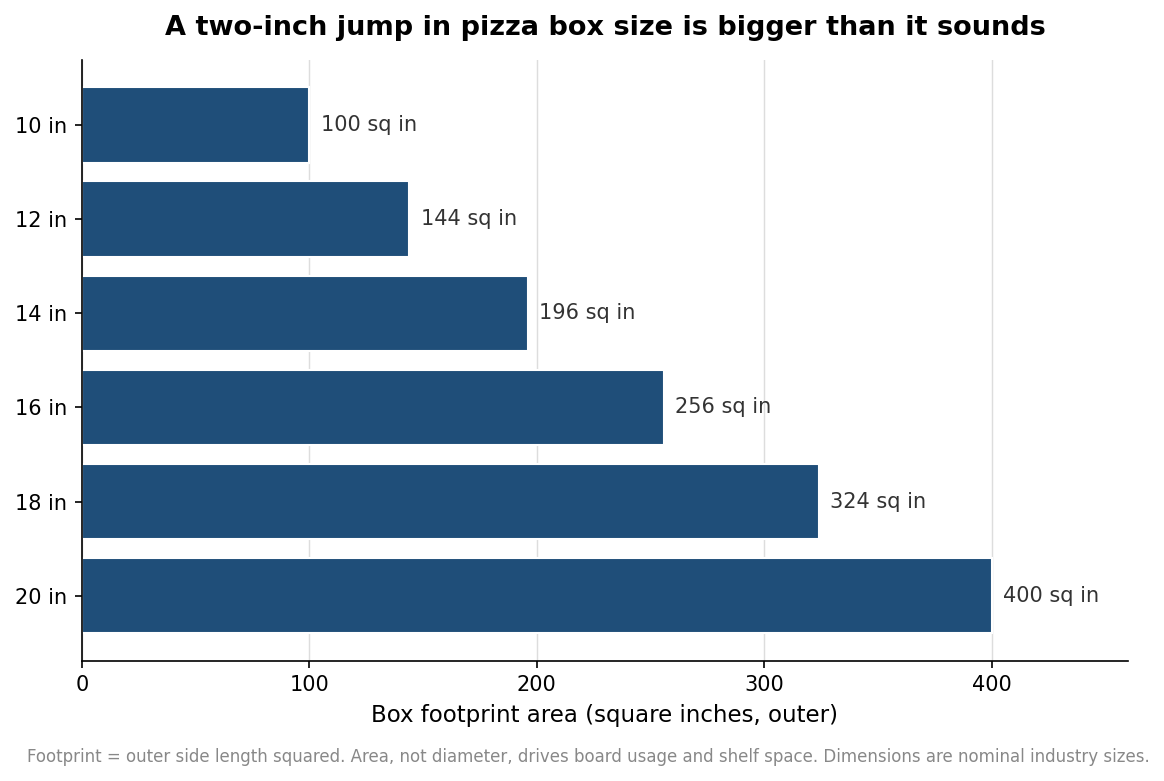
    What the chart makes obvious is that the jump between sizes is not linear. Going from a 14-inch box to an 18-inch box sounds like a modest step, but the footprint area climbs from 196 square inches to 324, roughly a 65 percent increase in board per box. That is why a small change in your default size moves both your material cost and the shelf and delivery-bag space each box occupies.

    Horizontal bar chart of pizza box footprint area in square inches for 10 to 20 inch boxes, showing nonlinear growth
    Footprint area grows with the square of the size, so a two-inch step is a larger material and space change than it appears.

    Depth is a separate decision from diameter

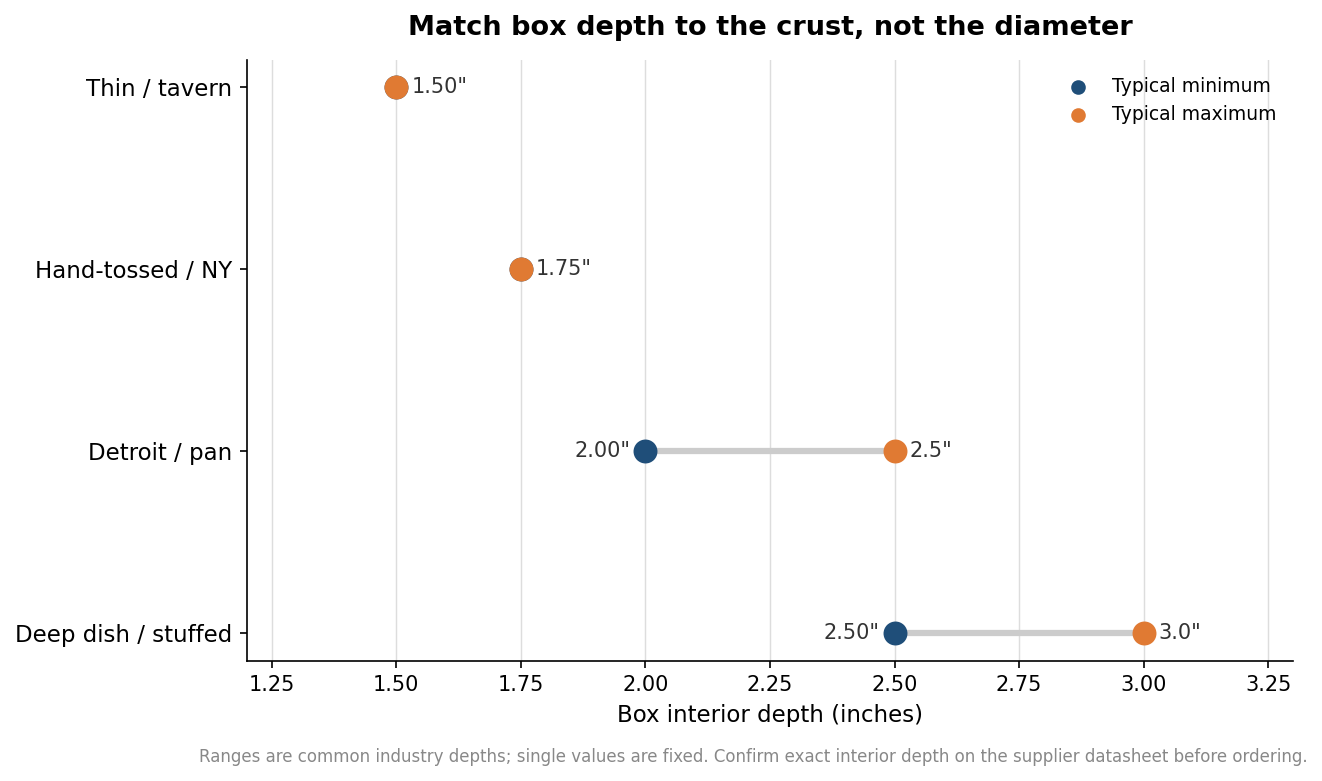
    Diameter carries the pizza; depth keeps the lid off the cheese. The two are chosen independently, and depth follows the crust rather than the size of the pie. A thin or tavern-cut pizza sits comfortably in a box around 1.5 inches deep. Hand-tossed and New York styles are the everyday default at about 1.75 inches, which is why so many stock boxes ship at that height. Detroit and pan pizzas need more room, generally 2 to 2.5 inches, and deep dish or stuffed crust can call for 2.5 to 3 inches so the lid never rests on the toppings.

    Get the depth wrong in either direction and it shows. Too shallow and the lid crushes the crown of the crust and drags cheese as it opens. Too deep and a thin pizza slides around under the extra headroom. If your menu spans several crust styles, it is common to standardize on one or two footprints and stock two depths rather than a separate box for every combination.

    Dot plot of pizza box interior depth ranges by crust style from thin at 1.5 inches to deep dish at 2.5 to 3 inches
    Box depth is chosen by crust style, independent of the pizza diameter.

    The quarter inch of clearance that keeps toppings in place

    The small gap between the pizza and the interior walls is engineered, not accidental. With the interior sitting about a quarter inch under the nominal size, a correctly matched pizza has just enough room to be placed and removed without forcing the crust into the corners. Give it much more room and the pie can slide in transit, sending toppings to one edge and pressing cheese against the wall. Give it much less and the crust compresses into the corners and can buckle the side panel.

    This is the practical case against sizing up “to be safe.” A 16-inch pizza belongs in a 16-inch box, not an 18-inch one. The extra footprint does not protect the pizza; it lets the pizza move. If you are unsure how a particular box fits a particular pie, ask the supplier for the interior floor dimensions rather than relying on the nominal label, since flute thickness varies slightly between board grades.

    How to specify a custom size without a reprint

    When you brief a custom run, lead with three numbers in order: length, width, and depth, all outer dimensions in inches. State the crust style you are packing so the supplier can sanity-check the depth against it. Confirm whether the quoted figure is the outer footprint or the interior floor, because a quarter-inch difference on each side changes both the fit and the usable print area. If your pies are cut to a house diameter that falls between standard sizes, say so early; it is far cheaper to adjust the tooling before printing than to discover the mismatch on the first pallet.

    It also helps to think one step past the box. A box has to fit the delivery bag and the shelf it lives on, so a footprint that looks fine on paper can be awkward once it is stacked forty deep or slid into an insulated carrier. Checking the box against the bag and the storage space before committing to a size avoids the most common and most expensive sizing mistake, which is ordering a diameter that does not fit the rest of the operation.

    Sizing a pizza box well comes down to two independent choices grounded in real numbers: the footprint that matches your pizza diameter, and the depth that matches your crust. Get those two right, respect the quarter inch of built-in clearance, and specify the box by dimension rather than by name, and the box will do its one job, which is to deliver the pizza looking exactly the way it left the oven.

  • Are Pizza Boxes Recyclable? Grease, Compost, and the New PFAS Rules

    Are Pizza Boxes Recyclable? Grease, Compost, and the New PFAS Rules

    The honest answer to whether pizza boxes are recyclable has changed in the last few years, and it is now mostly yes. The old rule that any grease spot sent the whole box to landfill has been walked back by the recycling industry itself, while a separate shift in regulation is quietly changing what the box is made of in the first place. For a pizzeria or delivery brand ordering custom boxes, the two threads matter together: how the box is disposed of, and whether its grease-resistance chemistry is about to be banned where you operate.

    The grease myth is mostly settled

    A greasy, cheesy pizza box can go in the recycling in most of the country. An American Forest and Paper Association study run with WestRock tested boxes at realistic contamination levels, on the order of a few percent of the recovered fiber stream, and found that small amounts of grease and cheese do not meaningfully harm the fiber bonding that recycling depends on. Larger chunks of baked-on cheese get screened out during pulping, and the study concluded there is no significant technical reason to keep post-consumer pizza boxes out of the recycle stream. In practice the mills agree: more than nine in ten of the association’s members that consume old corrugated containers report accepting pizza boxes.

    That does not mean you should recycle the leftover crusts with it. The right move for a customer is to scrape out loose food and toss any part of the liner that is soaked through or has cheese welded to it, then recycle the rest of the board. A lightly stained box is fine; a bottom panel swimming in oil is the part to tear off.

    Access still varies by local program

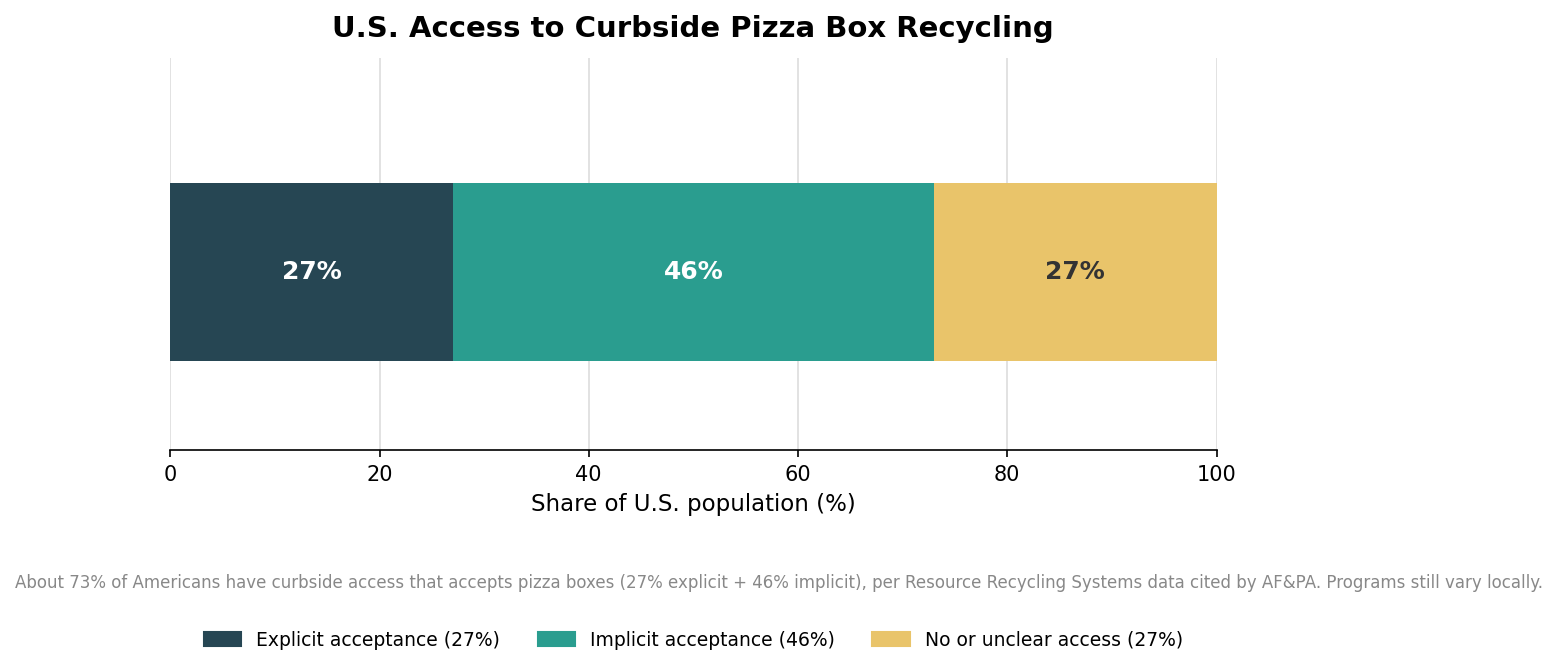
    The technical verdict is settled, but your local hauler still gets the final say. Not every curbside program has updated its rules, so acceptance is uneven across the map. Industry data cited by AF&PA puts roughly 73 percent of the U.S. population within a program that accepts pizza boxes, split between about 27 percent whose program explicitly names them as accepted and about 46 percent where they fall under general acceptance of corrugated cardboard. The remaining quarter or so either excludes them or gives no clear guidance.

    For a brand, the practical implication is that a blanket “100% recyclable” claim on the box can be misleading in the areas that still say no. A more defensible message points the customer to empty and check locally, which is both accurate and the behavior that keeps clean fiber flowing back to the mills.

    Stacked bar showing U.S. population access to pizza box recycling: 27 percent explicit acceptance, 46 percent implicit, 27 percent no or unclear access
    About 73% of Americans have curbside access that accepts pizza boxes, but roughly a quarter still do not.

    Recyclable and compostable are not the same thing

    A plain corrugated box can be both recyclable and compostable, but coatings break that. Uncoated kraft or white corrugated is the friendliest case: clean sections recycle, and heavily soiled sections actually compost well because the grease that hurts nothing in pulping is just carbon to a compost pile. The complication is barrier coatings. A wax or plastic (polyethylene) laminate that some boxes use for grease and moisture resistance is generally not accepted in the paper recycling stream and is not compostable either, so a coated box can end up less recoverable than a plain one despite looking more premium.

    If composting is the goal, the coating has to be certified for it. Compostable barrier treatments are tested against standards such as ASTM D6400 and ASTM D6868, and third-party marks like BPI certification signal that the whole box, coating included, will break down in a commercial composting facility. Without that certification, “eco” language on a coated box is not something you can stand behind. Where a figure or claim here is general rather than tied to a specific certified product, treat it as a starting point and confirm the certification on the exact board you buy.

    PFAS is changing what the coating can be

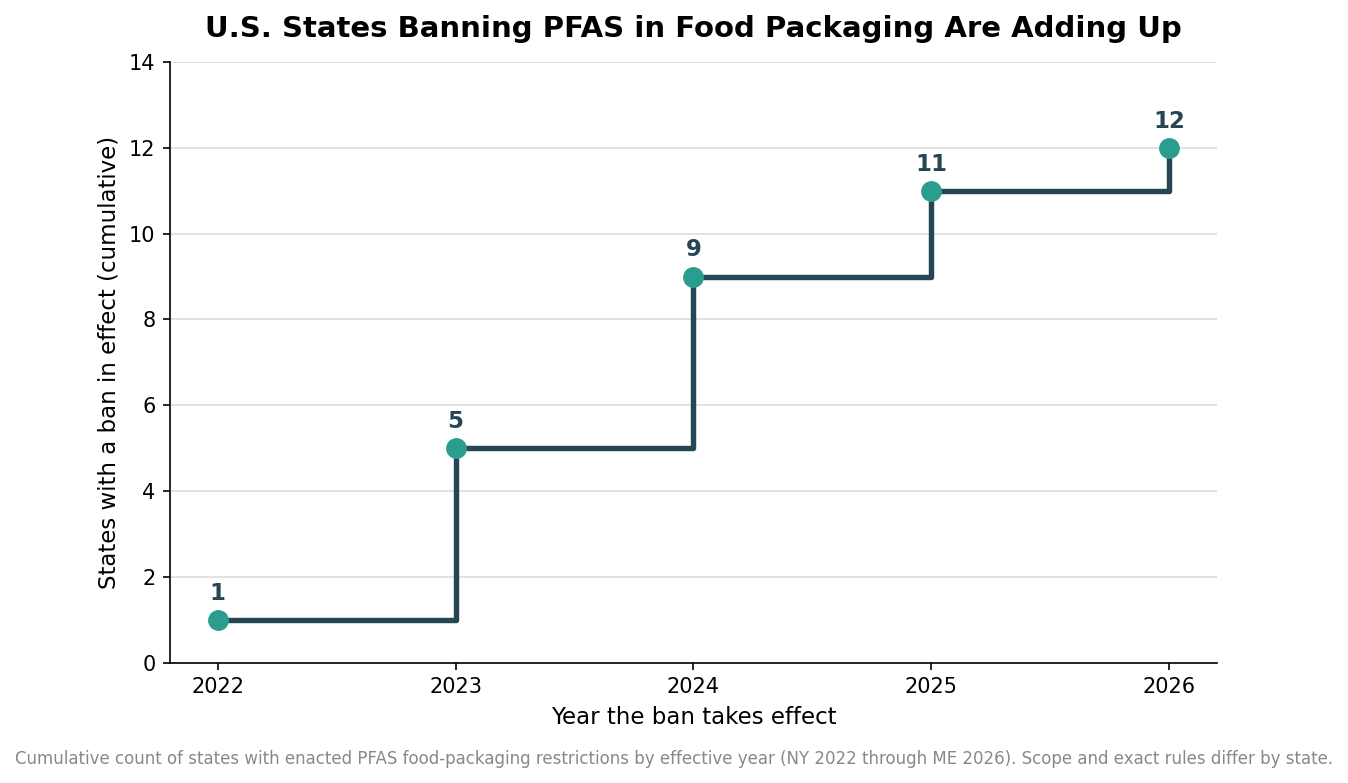
    The grease resistance in many older food boxes came from PFAS, and that is now being banned. Per- and polyfluoroalkyl substances, the so-called forever chemicals, were a common way to make paperboard shrug off oil, and food packaging is one of the first uses regulators have moved against. A growing list of states has enacted PFAS restrictions on food packaging, beginning with New York at the end of 2022 and running through California, Washington, Vermont, Connecticut, and then Minnesota, Maryland, Colorado, Hawaii, Oregon and Rhode Island, with Maine’s plant-fiber packaging rule scheduled for 2026. That is roughly a dozen states with bans in effect or scheduled, and the direction of travel is clear.

    For a buyer, this is a specification issue you cannot ignore if you ship into any of those states. The good news is that PFAS-free grease resistance is now widely available, using alternative treatments that keep oil out without the regulated chemistry. The action item is simply to ask your supplier to confirm the box is PFAS-free rather than assuming it, and to keep that confirmation on file as more states come online.

    Step chart showing the cumulative number of U.S. states with PFAS food-packaging bans in effect rising from 1 in 2022 to 12 by 2026
    State PFAS food-packaging bans are stacking up, so PFAS-free grease resistance is becoming a compliance requirement.

    What to spec, and what to print on the box

    Put the disposal story and the compliance story into the spec at the same time. Favoring uncoated or recyclable-coated corrugated keeps the box in the recovery stream where most customers can actually recycle it; specifying PFAS-free grease resistance keeps it legal to sell as food packaging in the expanding list of states that require it; and choosing a certified compostable coating only when you genuinely want compostability avoids the trap of a coated box that is neither recyclable nor compostable. On the print side, decoration normally sits on the outside of the box with food-grade inks, so the food-contact surface stays clean, and boards with recycled content are routinely used for this indirect-contact role.

    Finally, use the box itself to tell the customer what to do, because the recyclability gains are only real if people act on them. A short, honest line, empty the box and recycle the clean cardboard, check locally for greasy pieces, does more for your sustainability story than a broad claim the local program might not support.

  • Pizza Box Board Grades: B-Flute, E-Flute, and What the Corrugation Actually Does

    Pizza Box Board Grades: B-Flute, E-Flute, and What the Corrugation Actually Does

    Almost every decision that goes into a custom pizza box shows up on the quote: the size, the print method, the liner color, the coating. The one that rarely appears in plain language is the board grade, and it is the spec that quietly decides whether a box holds its heat, survives a long drive, and prints your logo sharp instead of soft. That board grade comes down to the flute, the wavy inner layer of the corrugation, and understanding it turns a vague conversation with a supplier into a specific one.

    What a flute actually is

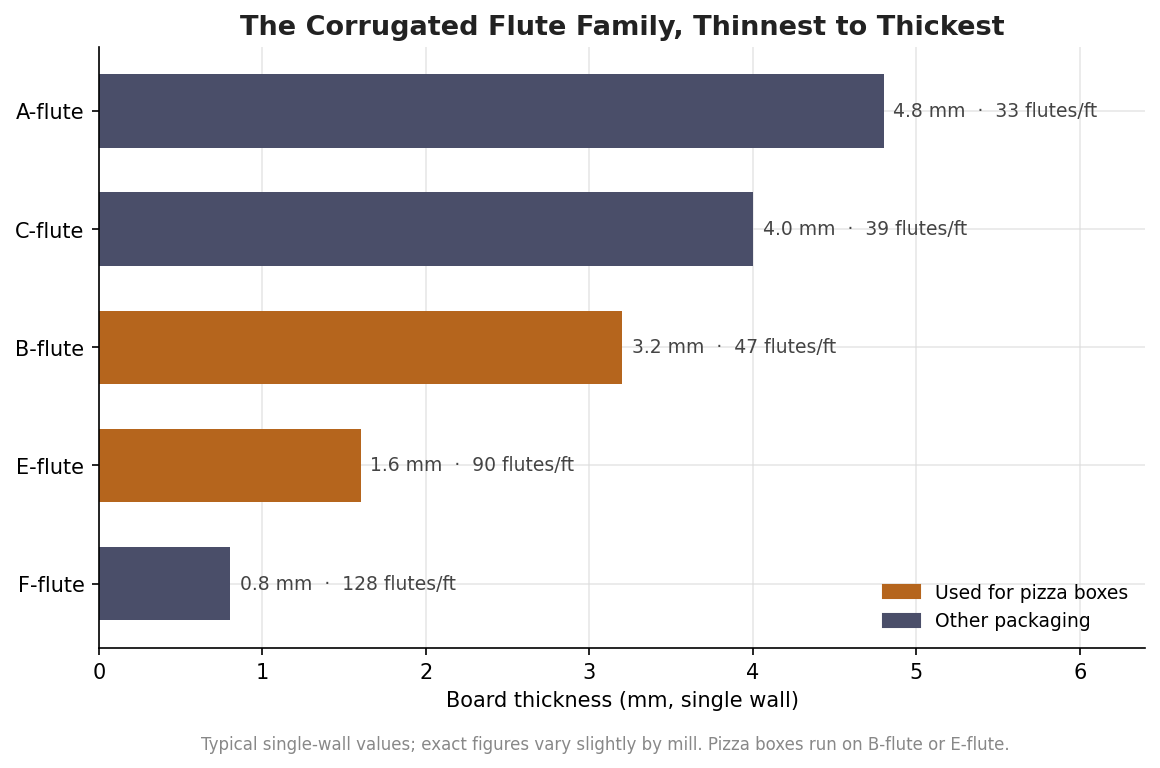
    Corrugated board is three layers: a flat outer liner, a flat inner liner, and a fluted wave glued between them. That wave is the whole point. It gives the board stiffness far beyond its weight, traps a layer of air for insulation, and sets how smooth the printing surface is. Flutes come in a standard family labeled by letter, and the letters are not sized in the order you would guess. Ranked from thinnest to thickest, F and E flutes are the fine ones, B sits in the middle, and C and A are the tall, heavily cushioning grades used for shipping and fragile goods. The thinner the flute, the more waves are packed into every foot of board, which is exactly the trade-off that matters for food packaging. Almost every pizza box is single wall, meaning one fluted layer between two liners; the double-wall boards used for heavy freight are overkill for a pizza and would add cost and bulk without a payoff. So the whole decision narrows to which single-wall flute sits between your two liners.

    Horizontal bar chart of corrugated flute thickness for A, B, C, E, and F flutes, with B-flute and E-flute highlighted as the grades used for pizza boxes.
    The corrugated flute family by thickness; pizza boxes run on the mid B-flute or the fine E-flute.

    Why pizza lives on B-flute and E-flute

    Out of that whole family, pizza boxes are built almost entirely on two grades. B-flute, at roughly 3.2 millimeters, is the traditional pizza board, thick enough to give a large box real rigidity and a cushion of air under a hot pie. E-flute, at about 1.6 millimeters, is roughly half the thickness with nearly twice the flutes per foot, which gives it a much flatter, finer surface. The taller flutes of A and C would over-build a pizza box and waste material, while F-flute is too thin to carry a heavy pizza across town. Everything a pizzeria weighs, from print quality to heat retention to how the box holds up in a delivery bag, is really a choice between these two grades.

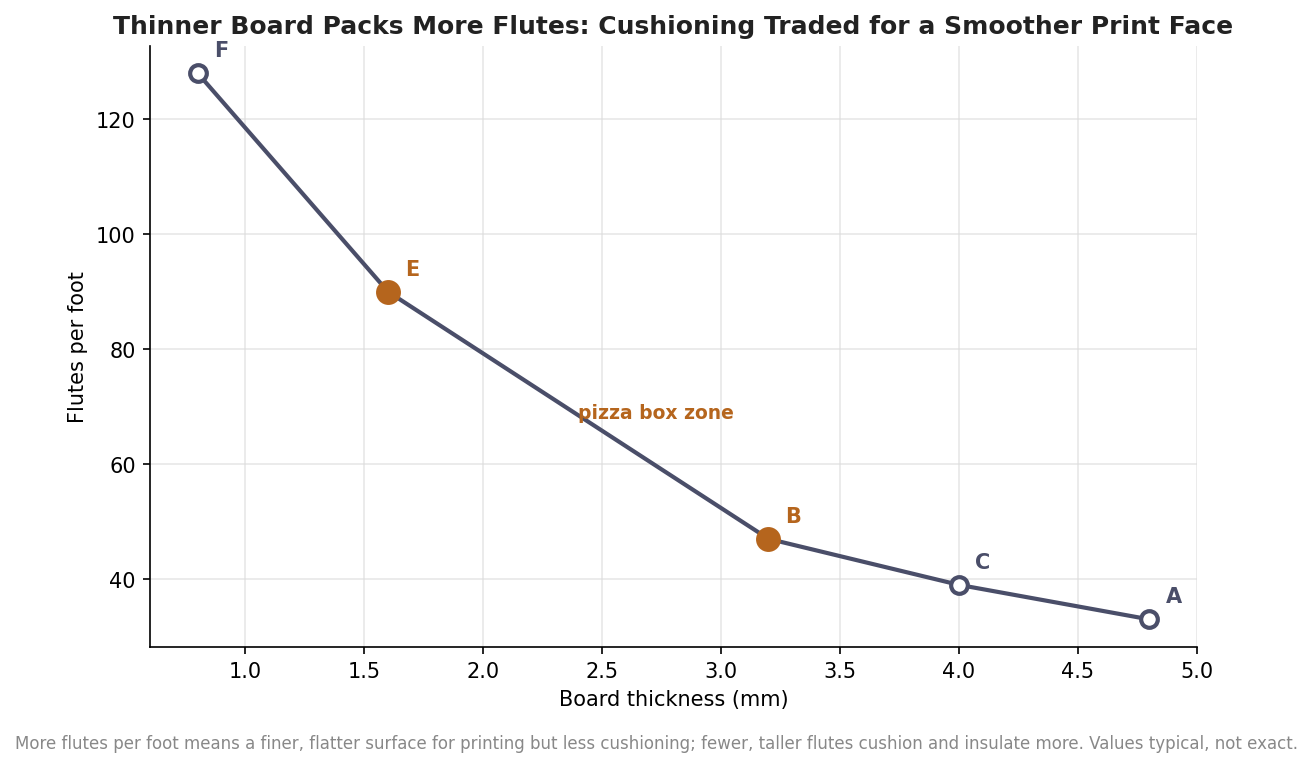
    Thinner board, more flutes, and what you trade

    The relationship between the two numbers is the key to the decision, and it is close to a straight line. As the flute gets shorter, the count per foot climbs steeply, and the surface the printer works on gets flatter and finer. That is why E-flute carries detailed, full-color artwork better than B-flute: there are simply more, smaller ridges under the ink, so fine type and photographic images do not fall into the wash-boarding you sometimes see on a coarse box. The cost of that smoothness is cushioning and stiffness. Fewer, taller flutes trap more air and resist crushing better, which is what B-flute buys you. Neither is better in the abstract; they sit at two ends of the same trade-off.

    Line chart showing flutes per foot rising sharply as board thickness falls, with B-flute and E-flute marked as the pizza box zone.
    As board gets thinner, flutes per foot climb, trading cushioning and insulation for a smoother printing surface.

    Heat, grease, and the drive across town

    For a food box, that trade-off translates into three practical behaviors. On insulation, the tighter cell structure of E-flute holds heat well and its flatter inner face can help manage the moisture that turns a crust soggy, while B-flute leans on its thicker air gap. On strength, B-flute is the safer choice for large pies and tall stacks in a warmer bag, because its taller flutes resist the crushing that flattens a box and smears the topping against the lid. On grease and moisture, the flute grade matters less than the liner and any coating, but a denser board simply has less open structure for oil to wick into over a long delivery. It is worth remembering that the flute works together with the liner: a clay-coated white liner gives ink a bright, smooth face and pairs naturally with the fine E-flute for premium print, while a kraft liner over B-flute reads as sturdier and more rustic. A short-run gourmet brand shipping a twelve-inch pizza a few blocks may favor E-flute for the print; a high-volume shop sending sixteen-inch pies across a metro area often stays on B-flute for the structure. Many suppliers stock both, so the honest first question is not which is better but which fits the way your boxes actually move.

    Speccing board for your operation

    The choice gets easier when you match the board to how the box actually travels. Start with your largest regular pizza size, because the bigger the box, the more the extra stiffness of B-flute earns its keep. Weigh your delivery profile next: long drives, stacked orders and hot bags reward structural board, while dine-in boxes, retail slices and pickup pies can lean thinner. Then decide how much your branding depends on fine print, because if the box is doing real marketing work with detailed artwork, E-flute’s smoother face may be worth the trade in cushioning. Ask your supplier to name the flute grade explicitly on the quote rather than accepting a generic corrugated, and request a plain sample of each candidate board so you can feel the difference before committing a full run. The board grade is a small line on the spec sheet, but it is the one that determines whether the box does its job from the oven to the doorstep.

  • How Custom Pizza Boxes Are Printed: Flexo, Digital, and Litho Compared

    How Custom Pizza Boxes Are Printed: Flexo, Digital, and Litho Compared

    Two pizzerias can order the exact same 14-inch box and end up with wildly different results, not because of the cardboard, but because of how the artwork was put onto it. The printing method behind a custom printed pizza box quietly decides three things that matter to every buyer: how many colors and how much detail you can show, how many boxes you have to order at once, and what each box costs. Pick the method that fits your artwork and your volume and everything lines up. Pick the wrong one and you either overpay for a short run or get stuck with a five-figure pallet of boxes you cannot use. Here is how the three common methods actually work and when each one wins.

    Flexography: the workhorse for volume

    Flexographic printing, or flexo, is what most people picture when they think of a printed pizza box. Raised images on flexible plates pick up ink from rollers and stamp it directly onto the board. It excels at bold, solid colors and clean text, and it typically runs one to four spot colors, which is plenty for a logo, a phone number, and a red-and-green Italian motif. What it does not do well is fine photographic detail or smooth gradients, because the process is built for punchy graphics rather than magazine imagery.

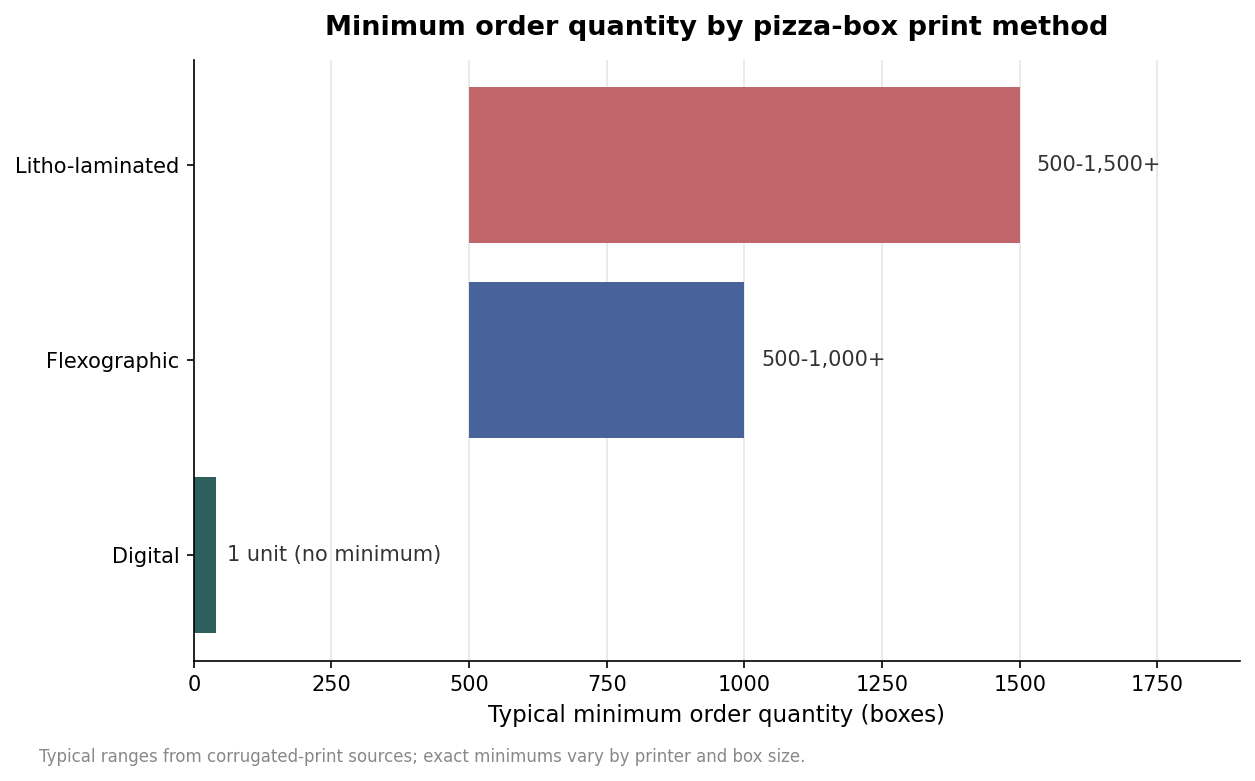
    The economics are all about the plates. A set of flexo plates commonly costs somewhere between 200 and 800 dollars or more, and that expense is fixed no matter how many boxes you print. Spread across 500 boxes it stings; spread across 20,000 it disappears. That is why flexo carries a real minimum order, generally in the range of 500 to 1,000-plus boxes, and why it delivers the lowest per-box cost once you are ordering in serious volume. If you are an established pizzeria going through cases every week, flexo is almost always the right home.

    Digital printing: full color with no minimum

    Digital printing skips plates entirely. High-resolution printheads spray ink straight onto the board from your artwork file, the same way an office printer works, only at packaging scale. Because there is nothing to set up, there is no plate cost and effectively no minimum, and you can order a single box if you want one. It prints full CMYK, so photographs, gradients, fine text, and unlimited colors all reproduce cleanly, and you can even change the design box to box for a seasonal promotion or a limited run.

    The trade-off is the per-unit price. Digital costs about the same to print the thousandth box as the first, so it never benefits from the plate-amortization curve that makes flexo cheap at scale. For a new pizzeria testing a design, a food truck running small batches, or a brand ordering a short seasonal edition, that flat cost is a feature. For a high-volume shop, it eventually becomes the expensive option.

    Range bar chart of typical minimum order quantity by pizza box print method: digital 1, flexo 500-1000, litho 500-1500
    Digital carries no real minimum; flexo and litho require several hundred boxes to start.

    Litho-lamination: magazine quality for premium brands

    Litho-lamination is the premium route. The artwork is printed on a flat paper sheet using an offset litho press, which produces the finest quality available, think magazine-grade color, crisp small type, metallic inks, and spot-gloss finishes. That printed sheet is then laminated onto the corrugated board so the box gets both the imagery and the structure. It supports full CMYK plus specialty finishes, which is why upscale frozen-pizza brands and retail-facing packaging lean on it.

    All that quality comes at a price. Litho-lamination carries both plate costs and the added lamination step, so it is the most expensive per unit of the three, and minimums typically start around 500 to 1,500-plus boxes. You choose it when the box is part of the product experience and the shelf impression justifies the spend, not when you simply need a functional delivery container.

    Matching the method to your quantity

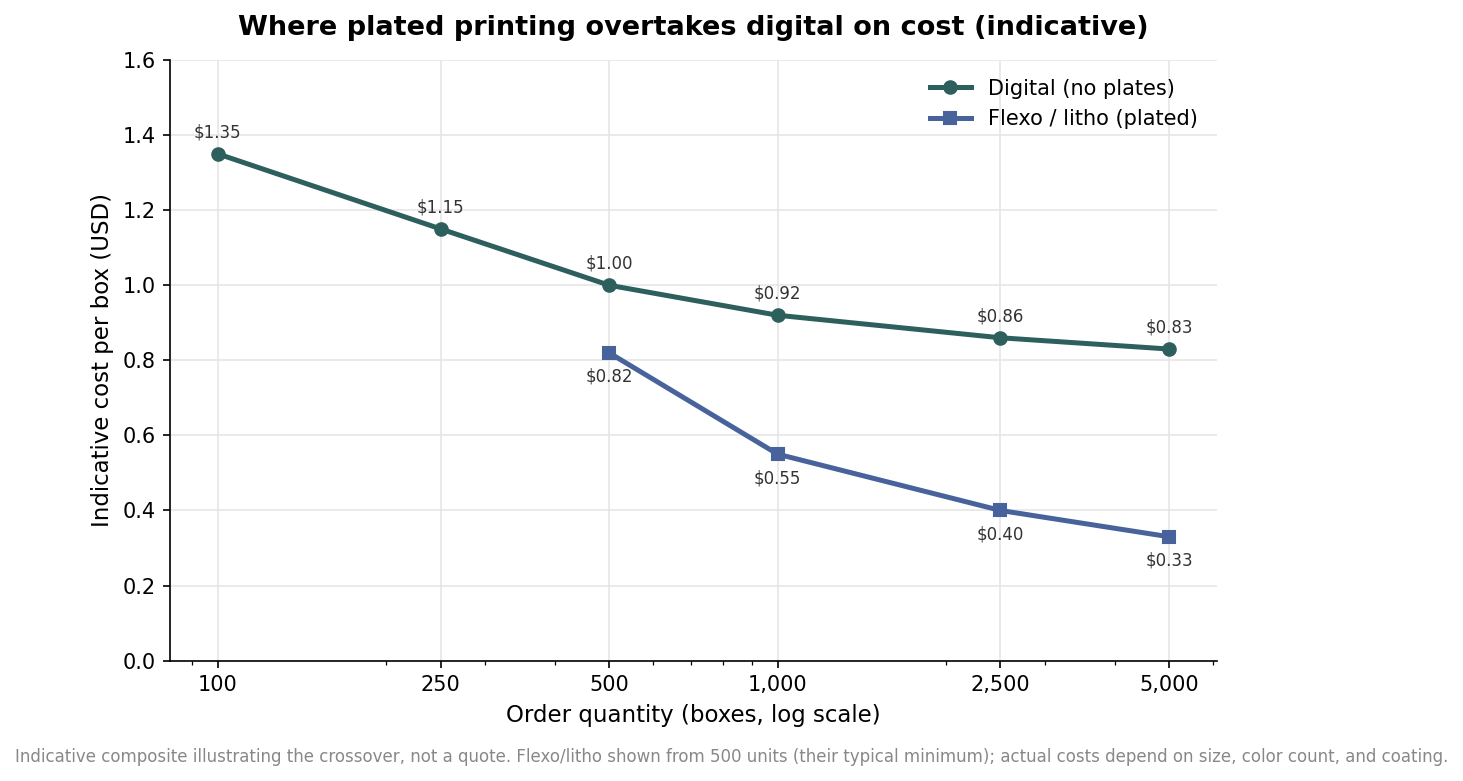
    The decision usually comes down to volume, because the three methods trade places on cost as your order grows. At small quantities, digital wins on price because there is no setup to pay off. As the order climbs past roughly 500 to 1,000 boxes, the plate cost on a flexo run finally spreads thin enough that flexo drops below digital and keeps falling. The chart below sketches that crossover; the exact point moves with box size, color count, and coating, so treat the shape as the lesson rather than the specific numbers. The practical rule is simple: order short, print digital; order deep, print flexo; and reserve litho-lamination for when the finish itself is selling the product.

    Line chart of indicative cost per pizza box versus order quantity, showing flexo overtaking digital past about 500 boxes
    Digital is cheapest for short runs; plated printing overtakes it as volume grows (indicative).

    Ink safety, board, and coating

    Whatever method prints your box, the substrate underneath still matters. Pizza boxes are corrugated, most often a lighter B-flute or E-flute that balances stacking strength against a smooth enough surface to print on. The board comes as natural kraft or as a bleached, clay-coated white; kraft is cheaper and reads as rustic and eco-friendly, while a coated white face gives colors more pop and is the usual base for litho work, at a higher material cost. Because the box holds hot food, printers keep the artwork on the outside and use food-appropriate, typically water-based inks, so nothing problematic sits against the pie. Grease resistance is handled by the board and any coating rather than by the print itself.

    Put the pieces together and the specification falls out naturally. Decide how much color and detail your design truly needs, be honest about how many boxes you will actually use in a buying cycle, and let those two answers point you to flexo, digital, or litho. Match the board and coating to the look you want, keep the inks food-safe, and the printed box will do its job on the counter and in the car without any expensive surprises.

  • A Pizzeria’s Guide to Pizza Box Margins — Customized Pizza Boxes

    Call or Text us: (929) 605-4397

    Home › Blog › A Pizzeria's Guide to Pizza Box Margins

    Retail

    A Pizzeria’s Guide to Pizza Box Margins

    06/15/2026

    Most independent pizzerias price a custom box as a straight cost against a plain, unprinted one, see the difference, and stop there. That comparison misses what a branded box actually does: it rides along on every single delivery and carryout order as free advertising, and it’s often the last thing a customer sees before they eat — and the first thing they photograph for social media.

    Here is a simple way to think about the margin math before your next order.

    The real per-unit gap

    A blank pizza box typically costs a modest amount depending on size; a custom flexo-printed version at the same volume usually adds only a small premium once you’re ordering in the thousands. At 5,000 units, that premium often works out to a fraction of the cost of a single topping.

    Where the return shows up

    A branded box functions as a repeated brand impression that sits on a kitchen counter, a shared office table, or a coffee table for the length of the meal — something a plain box never earns back. It also reduces the risk of an order mix-up in a multi-restaurant delivery bag, since your name is printed on the box itself.

    Order sizeRelative cost*
    12Highest tier
    2,000Mid tier
    5,000Low tier
    10,000+Lowest tier

    *Estimates only, illustrative of typical volume pricing — request a quote for your exact specs.

    Setting your menu price

    A simple rule of thumb: price the box as part of your cost of goods, not as a separate line item, and let the branding justify a small increase in your finished-pizza price rather than trying to recover it directly. Over a full production run, the packaging premium is almost always smaller than the perceived-value lift it buys, especially for delivery and ghost-kitchen orders where the box is the only physical brand touchpoint.

    Key takeawayA custom pizza box typically adds only a few cents per unit at volume, and the branding keeps working as free marketing long after the order arrives.

    Ready to upgrade your packaging? Get a custom quote — free mockups in 24 hours. Learn more about how we work, or browse more guides.

    More posts

  • How to Order Custom Pizza Boxes: A Step-by-Step Checklist — Customized Pizza Boxes

    Call or Text us: (929) 605-4397

    Home › Blog › How to Order Custom Pizza Boxes: A Step-by-Step Checklist

    Ordering

    How to Order Custom Pizza Boxes: A Step-by-Step Checklist

    05/27/2026

    Ordering a first batch of custom pizza boxes is simpler than most first-time buyers expect, but a little prep before you request a quote makes the whole process faster. Here’s the checklist we walk every new account through.

    1. Gather your artwork

    Vector files (AI, EPS, SVG, or PDF) print the cleanest and let us scale your logo to any box size without quality loss. If you only have a PNG, JPG, or a photo of a sign, that’s fine too — our designers will recreate it print-ready at no charge.

    2. Decide which sizes you need

    Look at your actual order mix before choosing sizes. Most accounts standardize on the 12in Medium Pizza Box for the bulk of orders, then add a 10in Personal, 14in Large, 16in XL, or Corrugated Deep-Dish Box depending on menu offerings.

    3. Pick a board finish

    Kraft brown suits simple, 1–2 color logos and a rustic brand feel. White-coated board makes full-color graphics and photography-style logos pop. See our kraft vs. white-coated comparison if you’re unsure.

    4. Estimate your quantity

    Approximate is fine at the quote stage — we’ll firm it up once you see the mockup. Our minimum is just 12 boxes per size, and pricing improves meaningfully as quantity increases.

    5. Confirm your timeline

    Standard production is 2 weeks (faster turnaround available with express shipping) from approved mockup. If you have a hard launch date, a new location opening, or a seasonal event, flag it upfront — rush production may be available.

    StepWhat we need from you
    1. ArtworkVector file, or a photo/PNG we can recreate
    2. SizesWhich of our 5 sizes fit your menu
    3. FinishKraft brown or white-coated
    4. QuantityApproximate is fine to start
    5. TimelineAny hard deadline for launch or event

    Choosing for your order

    Send us what you have on all five points, even if some answers are rough estimates. We’ll turn that into a photo-real mockup and bulk quote within one business day, and refine it with you at no charge until it’s exactly right.

    Key takeawayGather artwork, sizes, finish, quantity, and timeline before you request a quote — it turns a multi-day back-and-forth into a same-day mockup.

    Ready to start your order? Get a custom quote — free mockups in 24 hours. Learn more about how we work, or browse more guides.

    More posts

  • Grease-Resistant Pizza Boxes Explained — Customized Pizza Boxes

    Call or Text us: (929) 605-4397

    Home › Blog › Grease-Resistant Pizza Boxes Explained

    Durability

    Grease-Resistant Pizza Boxes: What Actually Keeps a Box From Soaking Through

    05/08/2026

    Every pizzeria has seen it: a box that arrives with a translucent grease stain spreading across the bottom, or worse, a soggy patch that sticks the crust to the board. It’s the single most common complaint about cheap pizza packaging, and it comes down to a handful of specific construction choices — not luck.

    Here’s what actually determines whether a box holds up.

    Board weight and flute matter more than most people think

    A thin, single-ply box has less material to absorb and redistribute grease before it reaches the surface. Our standard single-wall corrugated board is chosen specifically because the flute layer adds both structural rigidity and a buffer zone that slows grease penetration compared to flat, uncorrugated stock.

    Coatings do the heavy lifting

    The real grease-resistance work happens at the coating level. A food-safe grease-resistant coating on the interior surface of the board is what actually stops oil from wicking through to the outside, rather than the board material alone. This is a spec question worth asking about explicitly — not every “kraft box” on the market includes it.

    FactorEffect on grease resistance
    Single-wall vs. double-wallDouble-wall adds buffer time before soak-through
    Interior coatingPrimary defense — slows or stops oil penetration
    Box size vs. pie sizeAn undersized box concentrates grease in a smaller area
    Time in transitLonger delivery routes need more resistant board

    Sizing the box correctly also matters

    An undersized box crowds a pie against the walls and traps steam and oil in a smaller footprint, accelerating soak-through. Sizing your box correctly to your typical pie — and stepping up to a deep-dish or double-wall option for heavier, more heavily topped pies — does as much for grease performance as the coating itself.

    Choosing for your order

    For standard thin- and regular-crust pizzas, our single-wall board with a grease-resistant interior coating handles normal delivery times without issue. For deep-dish, heavily topped, or longer-transit orders, step up to our Corrugated Deep-Dish Box or ask about a double-wall upgrade on your standard size.

    Key takeawayGrease resistance comes from the interior coating and correct box sizing more than the board color — ask specifically about coating when you order.

    Want a box that holds up on your longest delivery route? Get a custom quote — free mockups in 24–48 hours. Learn more about how we work, or browse more guides.

    More posts

  • Custom Pizza Boxes for Food Trucks & Pop-Ups — Customized Pizza Boxes

    Call or Text us: (929) 605-4397

    Home › Blog › Custom Pizza Boxes for Food Trucks & Pop-Ups

    Food Trucks

    Custom Pizza Boxes for Food Trucks & Pop-Ups

    04/19/2026

    A food truck or pop-up pizza stand runs on constraints a brick-and-mortar restaurant doesn’t have to think about: limited storage, a fast-moving line, and a brand that has to make an impression in the few seconds a customer stands at the window. A branded pizza box does real work in that environment — it’s a mobile billboard at every festival, market, or event you set up at.

    Here’s how mobile and pop-up pizza brands should think about their boxes.

    Storage space is the real constraint

    Most trucks and stands don’t have room for five box sizes. We typically recommend standardizing on one or two sizes — usually the 10in Personal Pizza Box for single-slice or personal-pie service and the 12in Medium Pizza Box for a standard whole pie — rather than trying to stock a full size range in a space built for a kitchen, not a warehouse.

    The box is your signage at every event

    At a festival or farmers market, you often can’t control where your truck is parked relative to foot traffic, but you can control what walks away in a customer’s hands. A bold, full-bleed logo on the lid turns every sold pizza into a walking sign pointing back at your truck for the rest of the event.

    ConsiderationRecommendation for mobile brands
    Size rangeStandardize on 1–2 sizes to save storage space
    Print coverageFull-bleed lid for maximum event visibility
    Order timingOrder ahead of festival/event season, not the week of
    StackingFlat-packed boxes save truck storage until assembly

    Order ahead of your season

    Event and festival season books up production capacity across the industry fast. Because our standard lead time is two to three weeks, mobile vendors should plan a box order at least a month ahead of their first big event of the season rather than trying to rush an order the week before a festival.

    Choosing for your order

    Start with the 12in Medium Pizza Box as your core size, add the 10in Personal Pizza Box if you sell by the slice or in smaller portions, and lean into full-bleed print since your box is doing double duty as event signage. Order early enough in the season that a normal production timeline isn’t a scramble.

    Key takeawayA food truck’s box is mobile signage at every event — standardize on one or two sizes and order ahead of festival season.

    Ready to stock up before your next event? Get a custom quote — free mockups in 24–48 hours. Learn more about how we work, or browse more guides.

    More posts