Two pizzerias can order the exact same 14-inch box and end up with wildly different results, not because of the cardboard, but because of how the artwork was put onto it. The printing method behind a custom printed pizza box quietly decides three things that matter to every buyer: how many colors and how much detail you can show, how many boxes you have to order at once, and what each box costs. Pick the method that fits your artwork and your volume and everything lines up. Pick the wrong one and you either overpay for a short run or get stuck with a five-figure pallet of boxes you cannot use. Here is how the three common methods actually work and when each one wins.
Flexography: the workhorse for volume
Flexographic printing, or flexo, is what most people picture when they think of a printed pizza box. Raised images on flexible plates pick up ink from rollers and stamp it directly onto the board. It excels at bold, solid colors and clean text, and it typically runs one to four spot colors, which is plenty for a logo, a phone number, and a red-and-green Italian motif. What it does not do well is fine photographic detail or smooth gradients, because the process is built for punchy graphics rather than magazine imagery.
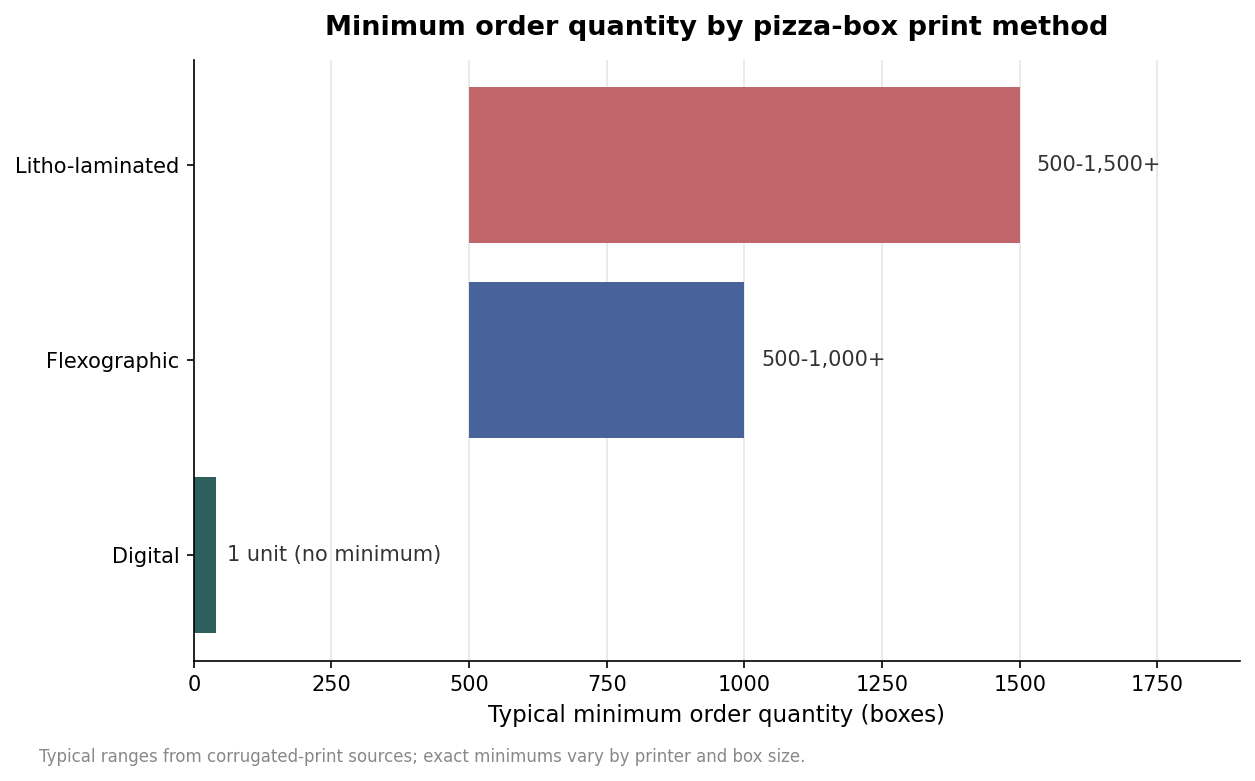
The economics are all about the plates. A set of flexo plates commonly costs somewhere between 200 and 800 dollars or more, and that expense is fixed no matter how many boxes you print. Spread across 500 boxes it stings; spread across 20,000 it disappears. That is why flexo carries a real minimum order, generally in the range of 500 to 1,000-plus boxes, and why it delivers the lowest per-box cost once you are ordering in serious volume. If you are an established pizzeria going through cases every week, flexo is almost always the right home.
Digital printing: full color with no minimum
Digital printing skips plates entirely. High-resolution printheads spray ink straight onto the board from your artwork file, the same way an office printer works, only at packaging scale. Because there is nothing to set up, there is no plate cost and effectively no minimum, and you can order a single box if you want one. It prints full CMYK, so photographs, gradients, fine text, and unlimited colors all reproduce cleanly, and you can even change the design box to box for a seasonal promotion or a limited run.
The trade-off is the per-unit price. Digital costs about the same to print the thousandth box as the first, so it never benefits from the plate-amortization curve that makes flexo cheap at scale. For a new pizzeria testing a design, a food truck running small batches, or a brand ordering a short seasonal edition, that flat cost is a feature. For a high-volume shop, it eventually becomes the expensive option.
Litho-lamination: magazine quality for premium brands
Litho-lamination is the premium route. The artwork is printed on a flat paper sheet using an offset litho press, which produces the finest quality available, think magazine-grade color, crisp small type, metallic inks, and spot-gloss finishes. That printed sheet is then laminated onto the corrugated board so the box gets both the imagery and the structure. It supports full CMYK plus specialty finishes, which is why upscale frozen-pizza brands and retail-facing packaging lean on it.
All that quality comes at a price. Litho-lamination carries both plate costs and the added lamination step, so it is the most expensive per unit of the three, and minimums typically start around 500 to 1,500-plus boxes. You choose it when the box is part of the product experience and the shelf impression justifies the spend, not when you simply need a functional delivery container.
Matching the method to your quantity
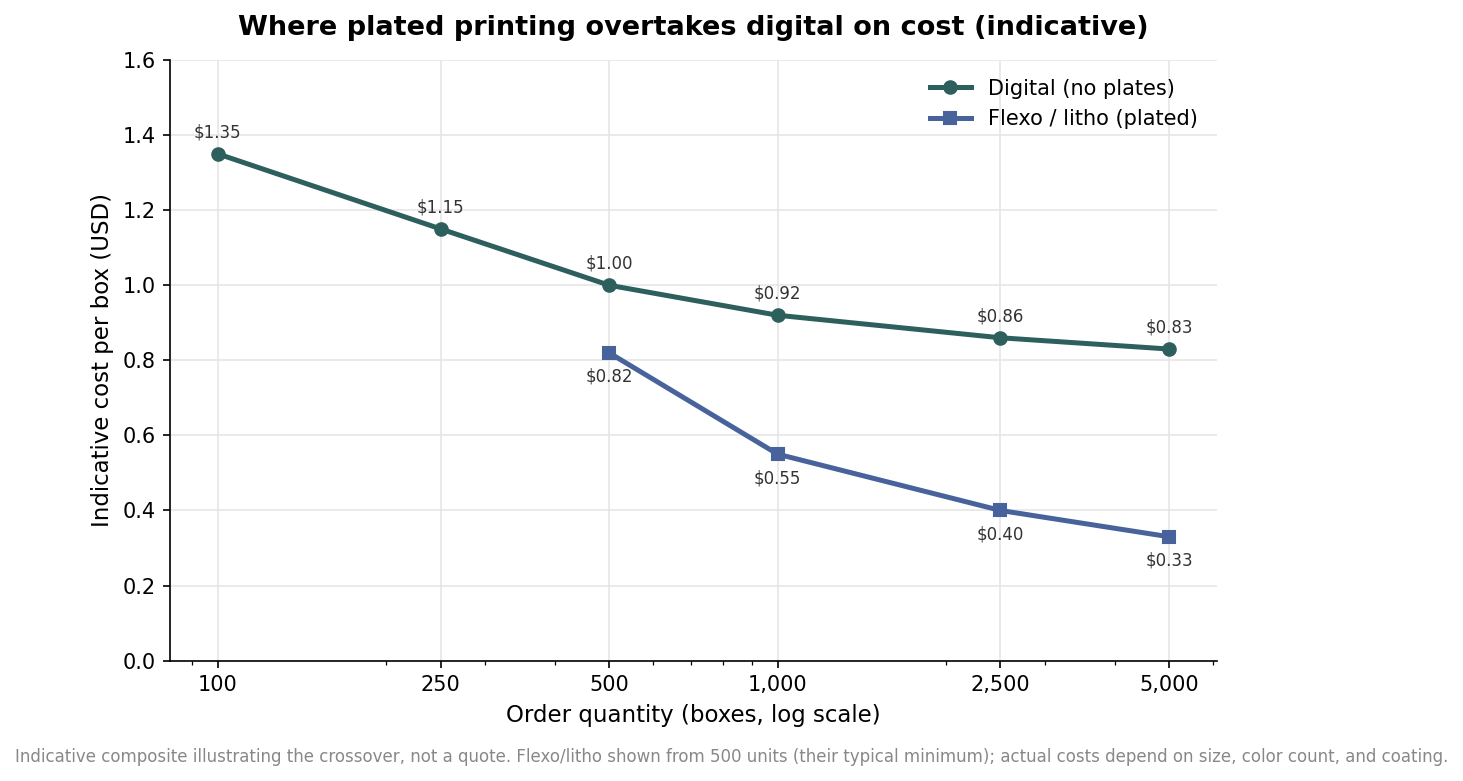
The decision usually comes down to volume, because the three methods trade places on cost as your order grows. At small quantities, digital wins on price because there is no setup to pay off. As the order climbs past roughly 500 to 1,000 boxes, the plate cost on a flexo run finally spreads thin enough that flexo drops below digital and keeps falling. The chart below sketches that crossover; the exact point moves with box size, color count, and coating, so treat the shape as the lesson rather than the specific numbers. The practical rule is simple: order short, print digital; order deep, print flexo; and reserve litho-lamination for when the finish itself is selling the product.
Ink safety, board, and coating
Whatever method prints your box, the substrate underneath still matters. Pizza boxes are corrugated, most often a lighter B-flute or E-flute that balances stacking strength against a smooth enough surface to print on. The board comes as natural kraft or as a bleached, clay-coated white; kraft is cheaper and reads as rustic and eco-friendly, while a coated white face gives colors more pop and is the usual base for litho work, at a higher material cost. Because the box holds hot food, printers keep the artwork on the outside and use food-appropriate, typically water-based inks, so nothing problematic sits against the pie. Grease resistance is handled by the board and any coating rather than by the print itself.
Put the pieces together and the specification falls out naturally. Decide how much color and detail your design truly needs, be honest about how many boxes you will actually use in a buying cycle, and let those two answers point you to flexo, digital, or litho. Match the board and coating to the look you want, keep the inks food-safe, and the printed box will do its job on the counter and in the car without any expensive surprises.
Leave a Reply