The honest answer to whether pizza boxes are recyclable has changed in the last few years, and it is now mostly yes. The old rule that any grease spot sent the whole box to landfill has been walked back by the recycling industry itself, while a separate shift in regulation is quietly changing what the box is made of in the first place. For a pizzeria or delivery brand ordering custom boxes, the two threads matter together: how the box is disposed of, and whether its grease-resistance chemistry is about to be banned where you operate.
The grease myth is mostly settled
A greasy, cheesy pizza box can go in the recycling in most of the country. An American Forest and Paper Association study run with WestRock tested boxes at realistic contamination levels, on the order of a few percent of the recovered fiber stream, and found that small amounts of grease and cheese do not meaningfully harm the fiber bonding that recycling depends on. Larger chunks of baked-on cheese get screened out during pulping, and the study concluded there is no significant technical reason to keep post-consumer pizza boxes out of the recycle stream. In practice the mills agree: more than nine in ten of the association’s members that consume old corrugated containers report accepting pizza boxes.
That does not mean you should recycle the leftover crusts with it. The right move for a customer is to scrape out loose food and toss any part of the liner that is soaked through or has cheese welded to it, then recycle the rest of the board. A lightly stained box is fine; a bottom panel swimming in oil is the part to tear off.
Access still varies by local program
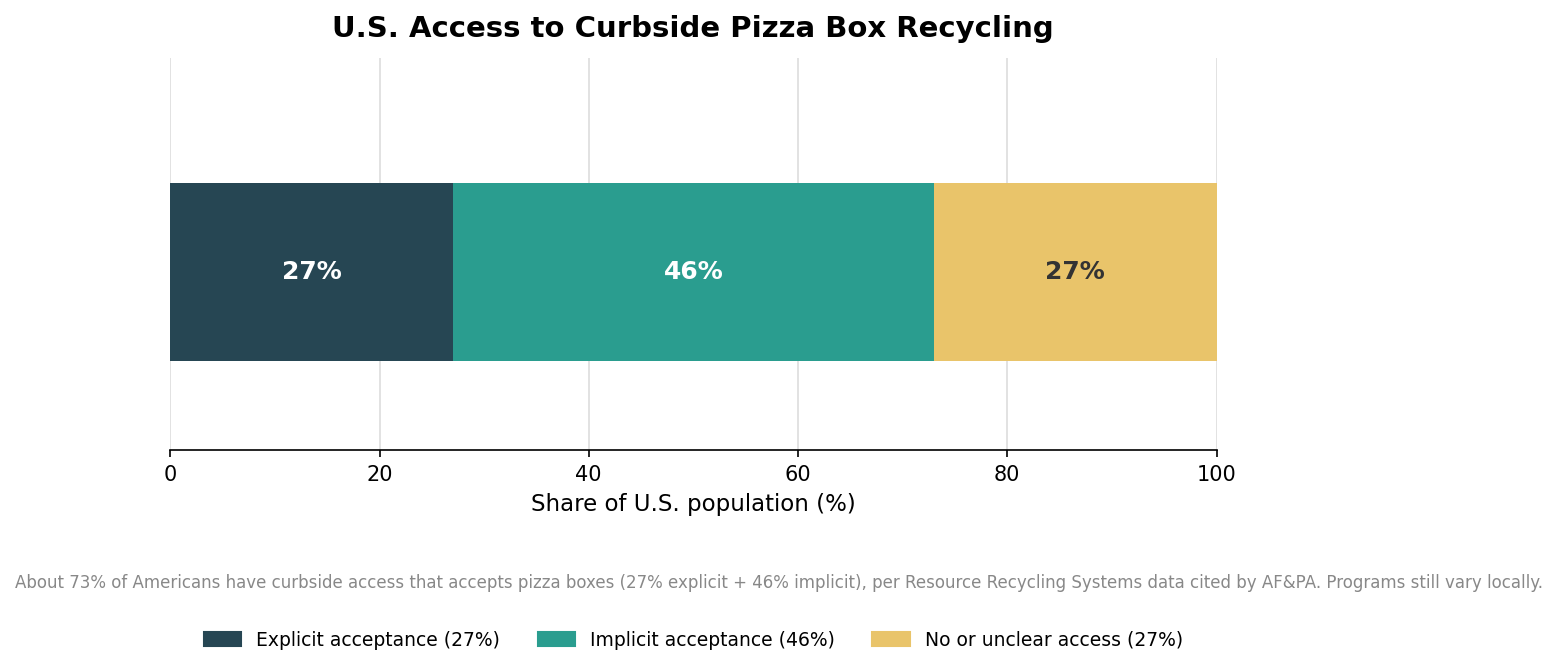
The technical verdict is settled, but your local hauler still gets the final say. Not every curbside program has updated its rules, so acceptance is uneven across the map. Industry data cited by AF&PA puts roughly 73 percent of the U.S. population within a program that accepts pizza boxes, split between about 27 percent whose program explicitly names them as accepted and about 46 percent where they fall under general acceptance of corrugated cardboard. The remaining quarter or so either excludes them or gives no clear guidance.
For a brand, the practical implication is that a blanket “100% recyclable” claim on the box can be misleading in the areas that still say no. A more defensible message points the customer to empty and check locally, which is both accurate and the behavior that keeps clean fiber flowing back to the mills.
Recyclable and compostable are not the same thing
A plain corrugated box can be both recyclable and compostable, but coatings break that. Uncoated kraft or white corrugated is the friendliest case: clean sections recycle, and heavily soiled sections actually compost well because the grease that hurts nothing in pulping is just carbon to a compost pile. The complication is barrier coatings. A wax or plastic (polyethylene) laminate that some boxes use for grease and moisture resistance is generally not accepted in the paper recycling stream and is not compostable either, so a coated box can end up less recoverable than a plain one despite looking more premium.
If composting is the goal, the coating has to be certified for it. Compostable barrier treatments are tested against standards such as ASTM D6400 and ASTM D6868, and third-party marks like BPI certification signal that the whole box, coating included, will break down in a commercial composting facility. Without that certification, “eco” language on a coated box is not something you can stand behind. Where a figure or claim here is general rather than tied to a specific certified product, treat it as a starting point and confirm the certification on the exact board you buy.
PFAS is changing what the coating can be
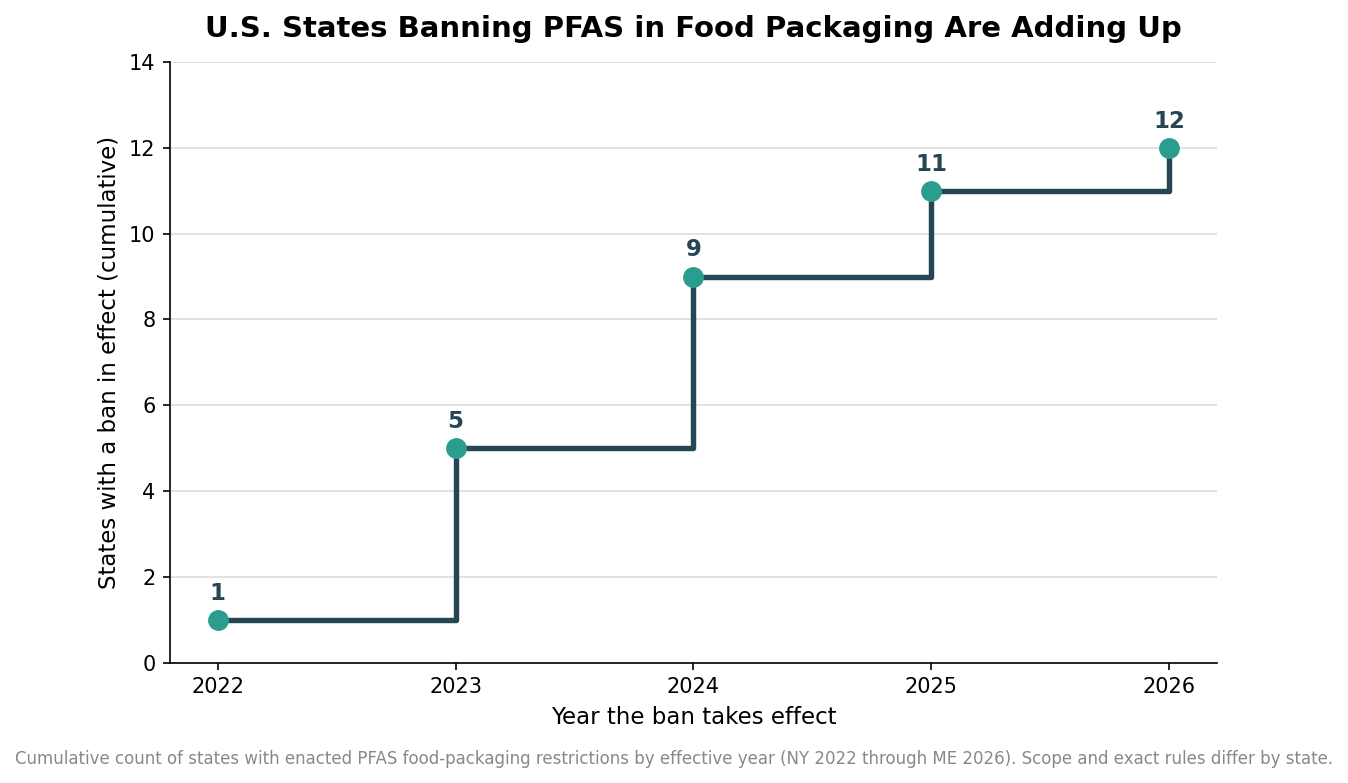
The grease resistance in many older food boxes came from PFAS, and that is now being banned. Per- and polyfluoroalkyl substances, the so-called forever chemicals, were a common way to make paperboard shrug off oil, and food packaging is one of the first uses regulators have moved against. A growing list of states has enacted PFAS restrictions on food packaging, beginning with New York at the end of 2022 and running through California, Washington, Vermont, Connecticut, and then Minnesota, Maryland, Colorado, Hawaii, Oregon and Rhode Island, with Maine’s plant-fiber packaging rule scheduled for 2026. That is roughly a dozen states with bans in effect or scheduled, and the direction of travel is clear.
For a buyer, this is a specification issue you cannot ignore if you ship into any of those states. The good news is that PFAS-free grease resistance is now widely available, using alternative treatments that keep oil out without the regulated chemistry. The action item is simply to ask your supplier to confirm the box is PFAS-free rather than assuming it, and to keep that confirmation on file as more states come online.
What to spec, and what to print on the box
Put the disposal story and the compliance story into the spec at the same time. Favoring uncoated or recyclable-coated corrugated keeps the box in the recovery stream where most customers can actually recycle it; specifying PFAS-free grease resistance keeps it legal to sell as food packaging in the expanding list of states that require it; and choosing a certified compostable coating only when you genuinely want compostability avoids the trap of a coated box that is neither recyclable nor compostable. On the print side, decoration normally sits on the outside of the box with food-grade inks, so the food-contact surface stays clean, and boards with recycled content are routinely used for this indirect-contact role.
Finally, use the box itself to tell the customer what to do, because the recyclability gains are only real if people act on them. A short, honest line, empty the box and recycle the clean cardboard, check locally for greasy pieces, does more for your sustainability story than a broad claim the local program might not support.
Leave a Reply