Almost every decision that goes into a custom pizza box shows up on the quote: the size, the print method, the liner color, the coating. The one that rarely appears in plain language is the board grade, and it is the spec that quietly decides whether a box holds its heat, survives a long drive, and prints your logo sharp instead of soft. That board grade comes down to the flute, the wavy inner layer of the corrugation, and understanding it turns a vague conversation with a supplier into a specific one.
What a flute actually is
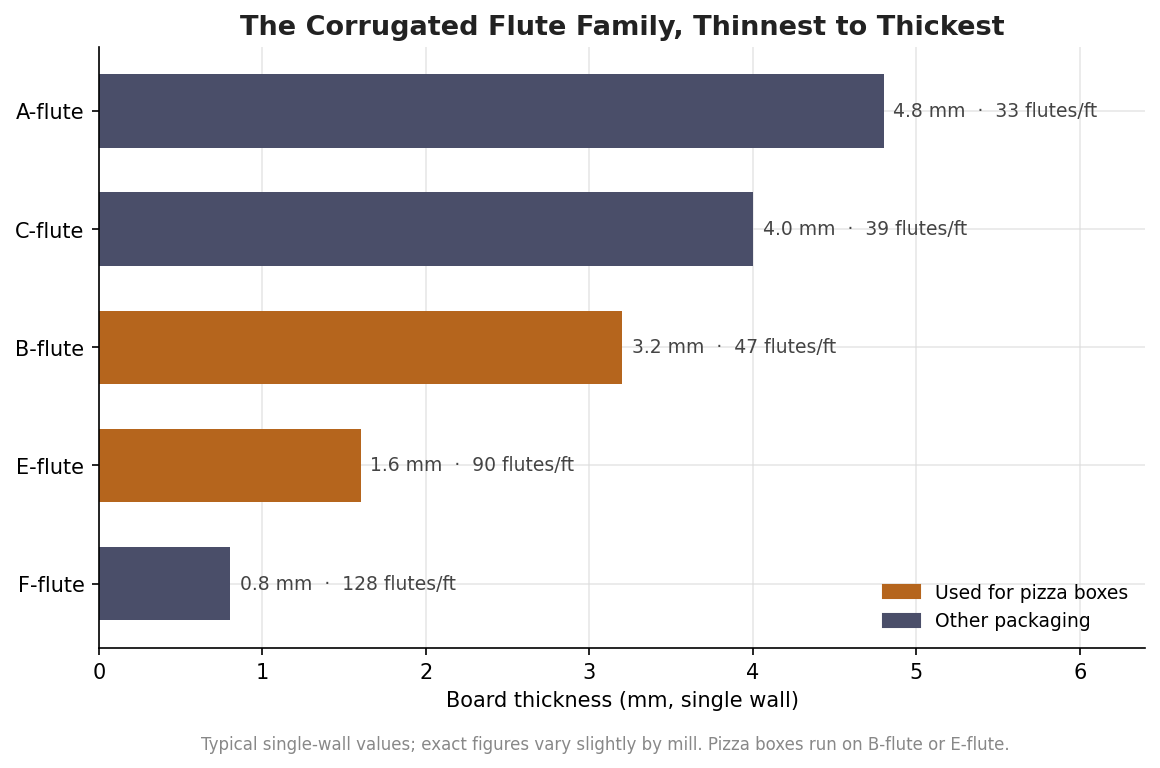
Corrugated board is three layers: a flat outer liner, a flat inner liner, and a fluted wave glued between them. That wave is the whole point. It gives the board stiffness far beyond its weight, traps a layer of air for insulation, and sets how smooth the printing surface is. Flutes come in a standard family labeled by letter, and the letters are not sized in the order you would guess. Ranked from thinnest to thickest, F and E flutes are the fine ones, B sits in the middle, and C and A are the tall, heavily cushioning grades used for shipping and fragile goods. The thinner the flute, the more waves are packed into every foot of board, which is exactly the trade-off that matters for food packaging. Almost every pizza box is single wall, meaning one fluted layer between two liners; the double-wall boards used for heavy freight are overkill for a pizza and would add cost and bulk without a payoff. So the whole decision narrows to which single-wall flute sits between your two liners.
Why pizza lives on B-flute and E-flute
Out of that whole family, pizza boxes are built almost entirely on two grades. B-flute, at roughly 3.2 millimeters, is the traditional pizza board, thick enough to give a large box real rigidity and a cushion of air under a hot pie. E-flute, at about 1.6 millimeters, is roughly half the thickness with nearly twice the flutes per foot, which gives it a much flatter, finer surface. The taller flutes of A and C would over-build a pizza box and waste material, while F-flute is too thin to carry a heavy pizza across town. Everything a pizzeria weighs, from print quality to heat retention to how the box holds up in a delivery bag, is really a choice between these two grades.
Thinner board, more flutes, and what you trade
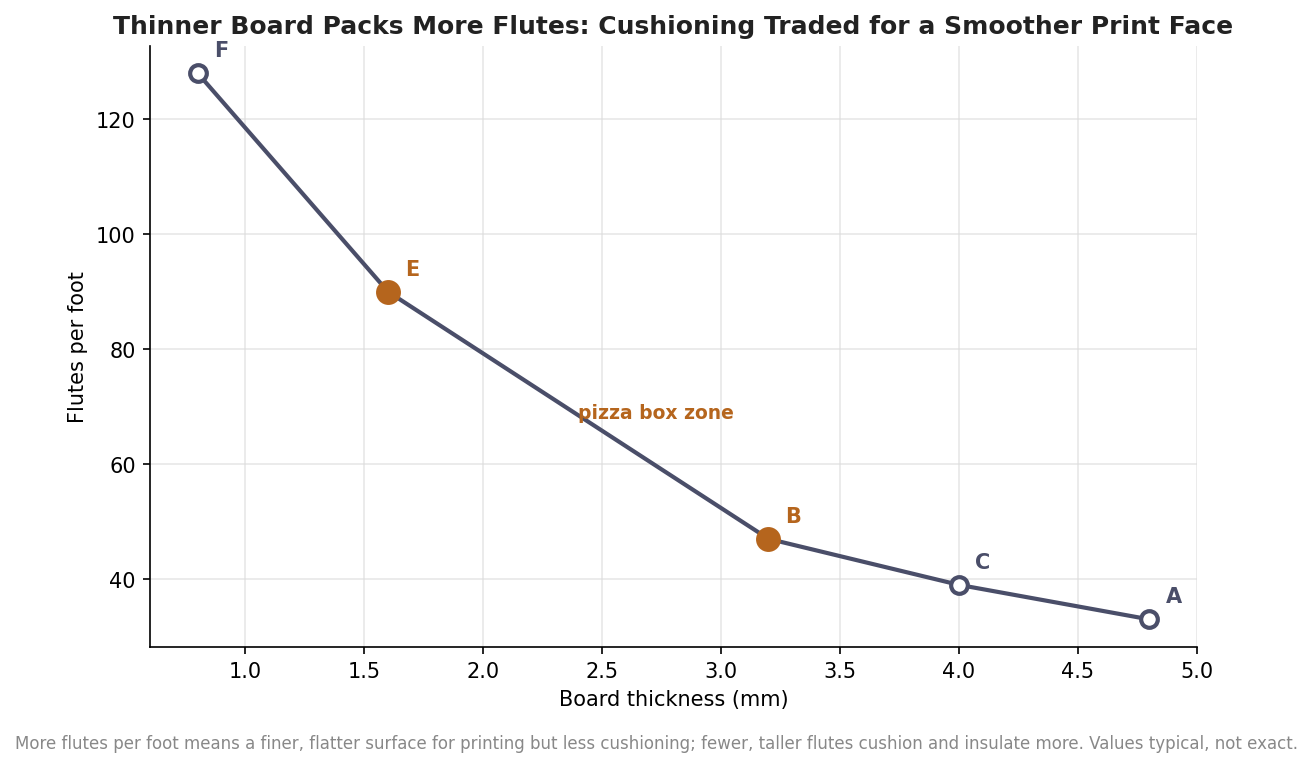
The relationship between the two numbers is the key to the decision, and it is close to a straight line. As the flute gets shorter, the count per foot climbs steeply, and the surface the printer works on gets flatter and finer. That is why E-flute carries detailed, full-color artwork better than B-flute: there are simply more, smaller ridges under the ink, so fine type and photographic images do not fall into the wash-boarding you sometimes see on a coarse box. The cost of that smoothness is cushioning and stiffness. Fewer, taller flutes trap more air and resist crushing better, which is what B-flute buys you. Neither is better in the abstract; they sit at two ends of the same trade-off.
Heat, grease, and the drive across town
For a food box, that trade-off translates into three practical behaviors. On insulation, the tighter cell structure of E-flute holds heat well and its flatter inner face can help manage the moisture that turns a crust soggy, while B-flute leans on its thicker air gap. On strength, B-flute is the safer choice for large pies and tall stacks in a warmer bag, because its taller flutes resist the crushing that flattens a box and smears the topping against the lid. On grease and moisture, the flute grade matters less than the liner and any coating, but a denser board simply has less open structure for oil to wick into over a long delivery. It is worth remembering that the flute works together with the liner: a clay-coated white liner gives ink a bright, smooth face and pairs naturally with the fine E-flute for premium print, while a kraft liner over B-flute reads as sturdier and more rustic. A short-run gourmet brand shipping a twelve-inch pizza a few blocks may favor E-flute for the print; a high-volume shop sending sixteen-inch pies across a metro area often stays on B-flute for the structure. Many suppliers stock both, so the honest first question is not which is better but which fits the way your boxes actually move.
Speccing board for your operation
The choice gets easier when you match the board to how the box actually travels. Start with your largest regular pizza size, because the bigger the box, the more the extra stiffness of B-flute earns its keep. Weigh your delivery profile next: long drives, stacked orders and hot bags reward structural board, while dine-in boxes, retail slices and pickup pies can lean thinner. Then decide how much your branding depends on fine print, because if the box is doing real marketing work with detailed artwork, E-flute’s smoother face may be worth the trade in cushioning. Ask your supplier to name the flute grade explicitly on the quote rather than accepting a generic corrugated, and request a plain sample of each candidate board so you can feel the difference before committing a full run. The board grade is a small line on the spec sheet, but it is the one that determines whether the box does its job from the oven to the doorstep.
Leave a Reply