Most people shopping for pizza boxes start with a word: small, medium, large. The trouble is that those words mean different things from one supplier to the next, and a box ordered by adjective has a way of arriving too shallow for the crust or a half inch too wide for the pie. The reliable approach is to order by dimension. Once you know the outer footprint, the interior depth, and how much clearance the pizza actually needs, choosing a size stops being guesswork and becomes a two-number decision.
This guide lays out the standard sizes side by side, explains why depth is a separate choice from diameter, and covers the small tolerances that decide whether a pizza travels flat or arrives with the toppings shoved into one corner.
Order by the number, not by the name
A pizza box is described by a single nominal figure that matches the pizza diameter it is built to carry. A 16-inch box is sized for a 16-inch pizza, a 12-inch box for a 12-inch pizza, and so on. That figure refers to the outer footprint of the box, measured across one side. Because corrugated board has real thickness, the usable interior runs roughly a quarter inch smaller than the nominal size on each side, so a box labeled 16 inches gives you a little under 16 inches of clear floor. That is deliberate, and it matters more than it looks, as the clearance section below explains.
Regional naming is the reason to distrust adjectives. One shop’s large is another’s medium, and “family size” is not a measurement at all. When you specify a custom run, give the outer length, width, and height in inches. It removes ambiguity from the quote and from the artwork, since the printable panel dimensions follow directly from the box size.
The standard pizza box size chart
The sizes below are the common industry footprints. Personal boxes run about 7 by 7 inches or 9 by 10 inches for a single-serve or two-slice pie. The everyday retail range covers 10, 12, 14, 16, and 18 inches square, and extra-large formats reach 20 by 20 or 24 by 24 inches for party pies. A 10-inch box is typically around 10 by 10 by 1.5 inches, a 12-inch box about 12 by 12 by 1.75 inches, a 14-inch box 14 by 14 by 1.75 inches, and 16- and 18-inch boxes about 2 inches deep. Treat those heights as the default for standard crusts; deeper styles are covered next.
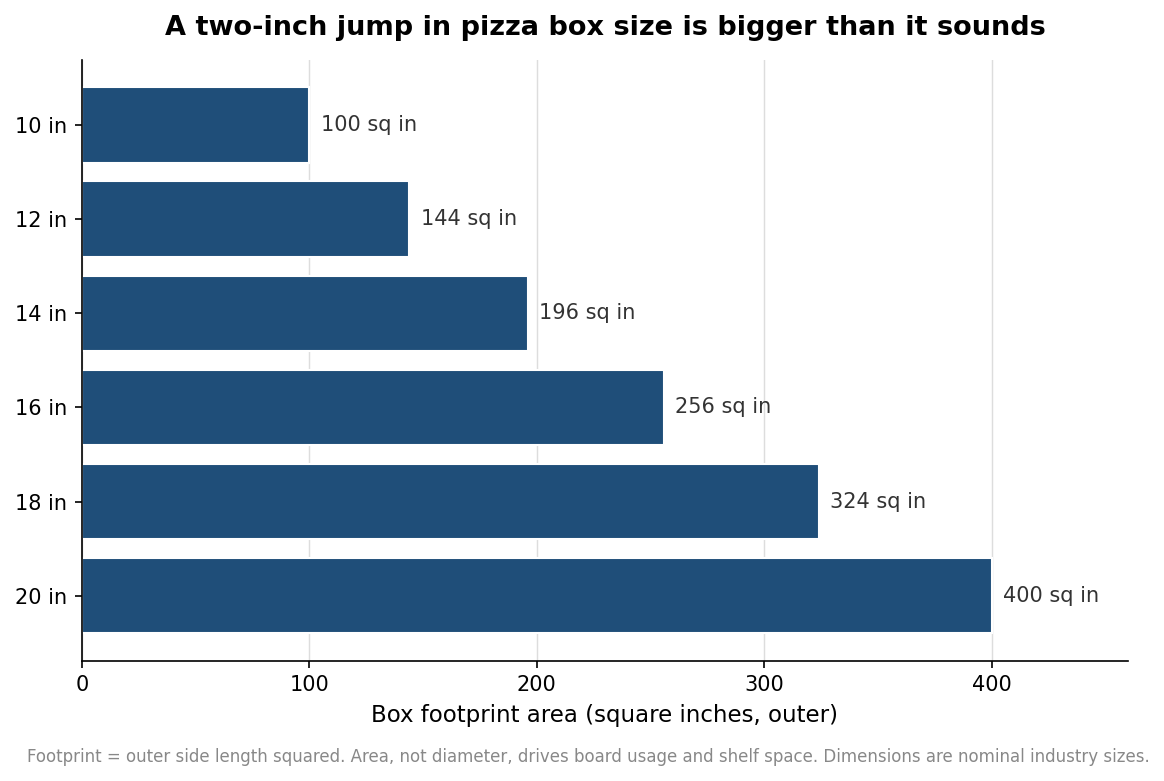
What the chart makes obvious is that the jump between sizes is not linear. Going from a 14-inch box to an 18-inch box sounds like a modest step, but the footprint area climbs from 196 square inches to 324, roughly a 65 percent increase in board per box. That is why a small change in your default size moves both your material cost and the shelf and delivery-bag space each box occupies.
Footprint area grows with the square of the size, so a two-inch step is a larger material and space change than it appears.
Depth is a separate decision from diameter
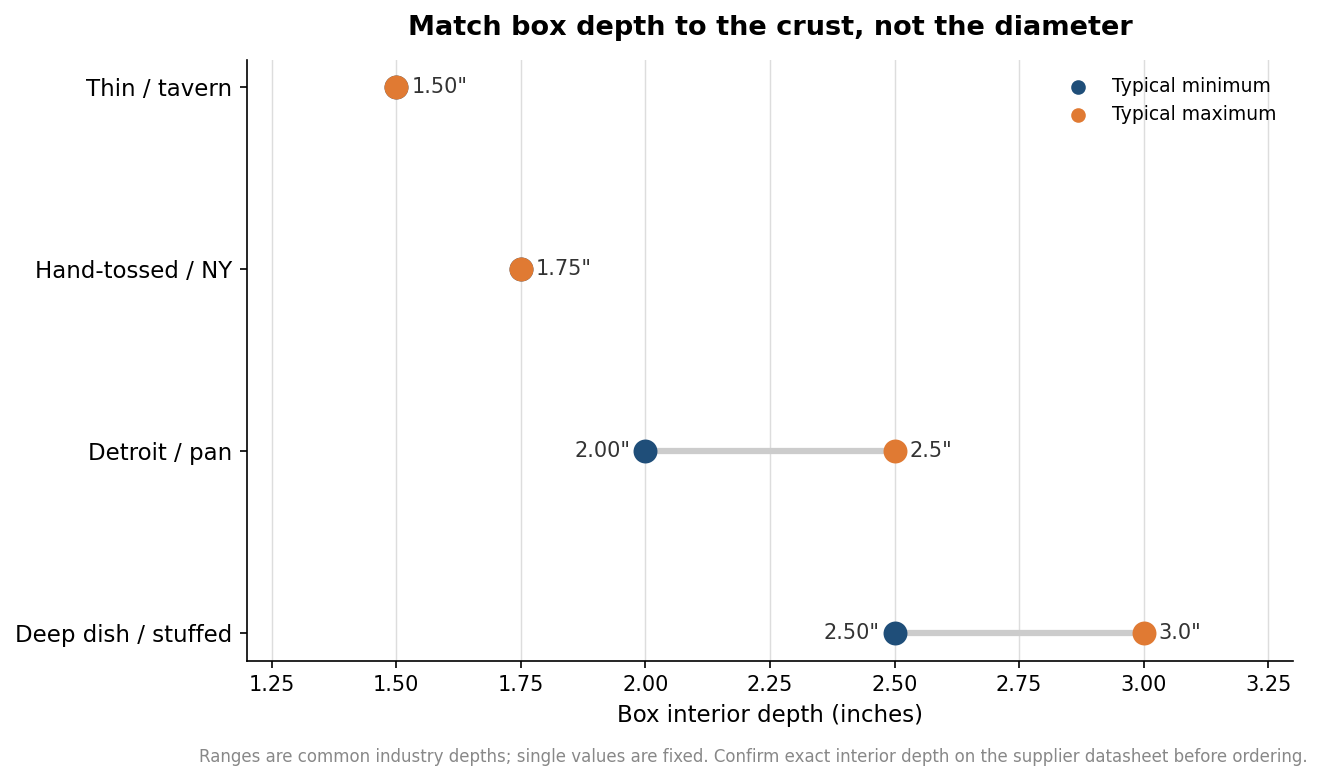
Diameter carries the pizza; depth keeps the lid off the cheese. The two are chosen independently, and depth follows the crust rather than the size of the pie. A thin or tavern-cut pizza sits comfortably in a box around 1.5 inches deep. Hand-tossed and New York styles are the everyday default at about 1.75 inches, which is why so many stock boxes ship at that height. Detroit and pan pizzas need more room, generally 2 to 2.5 inches, and deep dish or stuffed crust can call for 2.5 to 3 inches so the lid never rests on the toppings.
Get the depth wrong in either direction and it shows. Too shallow and the lid crushes the crown of the crust and drags cheese as it opens. Too deep and a thin pizza slides around under the extra headroom. If your menu spans several crust styles, it is common to standardize on one or two footprints and stock two depths rather than a separate box for every combination.
Box depth is chosen by crust style, independent of the pizza diameter.
The quarter inch of clearance that keeps toppings in place
The small gap between the pizza and the interior walls is engineered, not accidental. With the interior sitting about a quarter inch under the nominal size, a correctly matched pizza has just enough room to be placed and removed without forcing the crust into the corners. Give it much more room and the pie can slide in transit, sending toppings to one edge and pressing cheese against the wall. Give it much less and the crust compresses into the corners and can buckle the side panel.
This is the practical case against sizing up “to be safe.” A 16-inch pizza belongs in a 16-inch box, not an 18-inch one. The extra footprint does not protect the pizza; it lets the pizza move. If you are unsure how a particular box fits a particular pie, ask the supplier for the interior floor dimensions rather than relying on the nominal label, since flute thickness varies slightly between board grades.
How to specify a custom size without a reprint
When you brief a custom run, lead with three numbers in order: length, width, and depth, all outer dimensions in inches. State the crust style you are packing so the supplier can sanity-check the depth against it. Confirm whether the quoted figure is the outer footprint or the interior floor, because a quarter-inch difference on each side changes both the fit and the usable print area. If your pies are cut to a house diameter that falls between standard sizes, say so early; it is far cheaper to adjust the tooling before printing than to discover the mismatch on the first pallet.
It also helps to think one step past the box. A box has to fit the delivery bag and the shelf it lives on, so a footprint that looks fine on paper can be awkward once it is stacked forty deep or slid into an insulated carrier. Checking the box against the bag and the storage space before committing to a size avoids the most common and most expensive sizing mistake, which is ordering a diameter that does not fit the rest of the operation.
Sizing a pizza box well comes down to two independent choices grounded in real numbers: the footprint that matches your pizza diameter, and the depth that matches your crust. Get those two right, respect the quarter inch of built-in clearance, and specify the box by dimension rather than by name, and the box will do its one job, which is to deliver the pizza looking exactly the way it left the oven.
If you’ve started collecting quotes for custom pizza boxes, the spread probably looks confusing — one supplier quotes you under a dollar a box, another quotes over two dollars for what looks like the same spec. That gap isn’t random. It comes down to four variables: how many boxes you order, what size they are, what material they’re made from, and which printing method the supplier uses to put your logo on them. Most sales pages don’t walk you through all four before asking for your card number.
This guide breaks down what those variables actually cost, what minimum order quantities to expect, and how long production really takes, using figures pulled from working pizza box suppliers rather than a single vendor’s marketing page, so you can sanity-check whatever quote lands in your inbox.
How much do custom pizza boxes actually cost?
Price per box moves in a wide band because it’s driven almost entirely by quantity, not by the design itself. At the low end, small runs of custom pizza boxes ordered through digital printing tend to land between $0.50 and $2.00 per box, with the top of that range reserved for small quantities, oversized boxes, or extra features like a full-bleed interior print. Once an order grows into the thousands, offset printing brings the per-box cost down to roughly $0.10–$0.30, because the setup cost of plates gets spread across far more units.
Teal Packaging, a supplier that publishes volume pricing directly, lists per-unit costs starting around $0.44 once you’re ordering enough to qualify for its lower tiers, and CartonBar advertises custom pizza boxes starting near $0.70 a box on its smaller bundle sizes. Those two data points roughly bracket what a mid-size independent pizzeria should expect to pay before hitting true bulk volume. Box size matters too: an 18-inch box uses meaningfully more board than a 10-inch one, so expect large-format boxes to sit at the higher end of whatever price band your quantity puts you in.
The practical takeaway: don’t evaluate a quote on price per box alone without asking which quantity tier and printing method it’s based on. A $0.60 quote at 250 units and a $0.60 quote at 2,500 units are not the same deal — one of them has a lot more room to drop as you scale.
Per-box price falls roughly 5–10x as order volume moves from small digital runs to bulk offset runs.
Order Volume
Typical Price per Box
Likely Printing Method
50–250 units
$0.70 – $2.00
Digital
500–1,000 units
$0.44 – $0.70
Digital or Offset
1,000–5,000+ units
$0.10 – $0.30
Offset
Per-box price falls roughly 5–10x as order volume moves from small digital runs to bulk offset runs.Source: Teal Packaging and CartonBar wholesale pizza box pricing pages, plus industry pricing data aggregated via web search, accessed August 2026
Minimum order quantities: what suppliers actually require
Minimum order quantities for custom pizza boxes have come down significantly as digital printing has gotten cheaper. Several suppliers now accept runs as small as 50 boxes, with a common floor of 100 units for standard corrugated styles — that’s low enough for a single-location restaurant to test a new box design without committing to a warehouse full of inventory. Specialty formats, like rigid or fully custom die-cut shapes, tend to carry a higher floor, often around 100 units minimum even at suppliers that go lower on standard styles.
Offset printing is a different story. Because it requires burning printing plates before a single box gets made, most offset runs only make financial sense at 500–1,000 units and up — below that, the plate cost outweighs any per-unit savings versus digital. If your order sits right on that line, ask your supplier to quote both methods; the crossover point shifts depending on how many ink colors your design uses.
Digital vs. offset: which should you order?
Digital printing has effectively no setup cost, which is why it’s the default for anything under a few hundred units, for one-off promotions, or for boxes that need variable data like a QR code or location-specific text. Offset printing costs more to set up but produces a lower per-unit price and, in most side-by-side comparisons, a slightly crisper, more saturated print — worth it once you’re ordering consistently in bulk. If you’re not sure which side of that line your order falls on, request quotes for both; most box printers will run the numbers either way.
Choosing a material and flute
Almost every custom pizza box on the market is corrugated cardboard, but the flute — the wavy inner layer between the two flat sheets — comes in a couple of common grades that change how the box performs. B-flute runs about 3mm thick and holds up well under stacking and heavier pies like deep-dish; E-flute is thinner, around 1.5mm, with tighter flute spacing that gives a smoother, more print-friendly outer surface and slightly better heat retention. Neither one is objectively better — B-flute is the safer default if you’re stacking boxes in a delivery bag or handling a lot of loaded, heavy pizzas, while E-flute is worth choosing if crisp branding on the lid is the priority.
Kraft (unbleached brown) and white corrugated are the two base finishes, and the choice is mostly aesthetic — white gives brighter, more accurate color printing, kraft gives a more rustic, recyclable-looking finish that some brands lean into on purpose. What matters more than either is the inner coating. Plain corrugated board is not grease-resistant on its own; without a barrier layer, grease and cheese oil migrate through the flute channels and show up as brown staining on the outside of the box, often within two to three days of regular use. A PE (polyethylene) liner solves this cheaply but isn’t recyclable with the rest of the box; an aqueous, water-based coating keeps the box recyclable but historically performed a bit worse against heavy grease, though newer formulations have closed most of that gap. If curbside recyclability is part of your brand story, ask for FSC-certified kraft corrugated with an aqueous coating specifically — plenty of suppliers offer PE-coated board by default because it’s cheaper to produce.
Picking the right box size
Pizza boxes are sized to match the pizza’s outer diameter, and the industry has settled on a handful of standard footprints: 10, 12, 14, 16, and 18 inches square. A 14-inch box — typically 14 x 14 x 1.75 or 2 inches — covers the large pizza sold by the overwhelming majority of independent pizzerias and every major national chain, which is why it’s usually the highest-volume SKU in any custom order. Depth ranges from about 1.5 inches on a 10-inch box up to 2 inches on 16- and 18-inch boxes, with deep-dish versions typically needing another half-inch to inch of clearance.
One sizing quirk worth knowing before you finalize art: boxes are labeled by their outer dimension, not the usable interior. A box marked 14 inches measures 14 inches across the outside edge, which leaves roughly 13.75 inches of interior space once you account for the board thickness — plan your pizza sizing (and any interior printing) with that margin in mind rather than treating the label as exact.
Most independent pizzerias stock three sizes — 12, 14, and 16 inch — rather than the full five-size range, since 10-inch boxes are mainly useful for kids’ menus or single slices and 18-inch is a niche, party-size item. If you’re placing your first custom order, starting with your one or two highest-volume sizes and adding the rest later keeps your minimum order requirement manageable per SKU.
Lead times: how far ahead to order
Production time is the number most first-time buyers underestimate. Standard runs of custom pizza boxes typically take 8–10 business days to produce once art is approved, and that’s before shipping — add another 2–4 days for delivery, which puts a realistic total closer to two to three calendar weeks from approved proof to boxes on your loading dock. If you’re ordering ahead of a known event, like a menu relaunch or a seasonal promotion, back-planning from that window matters more than the sticker price.
Most suppliers also offer a rush option, typically cutting turnaround to 4–5 business days for an upcharge, and a sample order — usually a handful of proof boxes — that ships in 3–5 business days so you can check color accuracy and board quality before committing to a full production run. Given how much variation exists between a screen proof and an actual printed box, ordering a physical sample before your first full run is worth the extra few days almost every time.
A standard order takes roughly two to three weeks door-to-door once shipping is added to production time.
Order Type
Typical Turnaround
Sample / proof order
3–5 business days
Standard production
8–10 business days + 2–4 days shipping
Rush production
4–5 business days (upcharge applies)
A standard order takes roughly two to three weeks door-to-door once shipping is added to production time.Source: Turnaround times aggregated from pizza box supplier product pages (Rush Custom Boxes, Adcopac, PackYolo) via web search, accessed August 2026
Getting your design order-ready
Most suppliers print on one to five sides of the box — top, bottom, and the four side panels — and charge the same setup regardless of how many of those you use, so it’s worth designing for all of them rather than just the lid. The side panels are prime real estate for a phone number, website, or social handle that stays visible even when boxes are stacked in a warehouse or delivery bag. Keep critical text and logos away from the score lines where the box folds; art that straddles a fold line tends to crack or distort slightly during assembly, especially on kraft stock.
If you’re ordering custom pizza boxes for the first time, send your supplier a vector file (AI, EPS, or a high-resolution PDF) rather than a flattened JPEG or PNG — corrugated printing enlarges small imperfections in low-resolution art more than most people expect, and a vector file avoids that entirely.
Frequently asked questions
What’s the minimum order for custom pizza boxes?
Many suppliers now accept runs as small as 50–100 boxes using digital printing, which covers most standard corrugated styles. Specialty or fully custom die-cut shapes usually carry a higher floor, often around 100 units. Offset printing, which produces a lower per-box cost, generally only makes sense starting around 500–1,000 units because of the upfront cost of printing plates.
How much does it cost to order custom pizza boxes?
Expect roughly $0.70–$2.00 per box on small digital-printed runs of a few hundred units, dropping to around $0.44–$0.70 in the 500–1,000 unit range, and down to $0.10–$0.30 per box once you’re ordering in the thousands through offset printing. Box size, flute grade, and any grease-barrier coating all shift the price within those bands.
How long does it take to get custom pizza boxes made?
Standard production runs about 8–10 business days after you approve the art, plus 2–4 days of shipping, so plan on two to three weeks total for a first order. Rush production can shrink that to 4–5 business days for an added fee, and sample or proof orders typically ship in 3–5 business days.
What’s the difference between E-flute and B-flute pizza boxes?
B-flute is thicker, at roughly 3mm, and offers better crush resistance for stacked or heavier pizzas like deep-dish. E-flute is thinner, around 1.5mm, with a smoother surface that prints more sharply and slightly better insulation from its tighter flute spacing. Neither is strictly better — the choice comes down to whether durability or print quality matters more for your boxes.
Do custom pizza boxes need a grease-resistant coating?
Plain corrugated board isn’t grease-resistant by default — oil from cheese and toppings can migrate through the flute channels and stain the outside of the box within a couple of days of regular use. A PE (polyethylene) liner is the cheapest fix but isn’t recyclable with the rest of the box; an aqueous, water-based coating keeps the box recyclable and has largely closed the performance gap in recent formulations.
What size pizza box do I need?
Standard sizes run 10, 12, 14, 16, and 18 inches square, matched to the pizza’s diameter, with 14-inch covering the large pizza sold by most pizzerias and chains. Most independent restaurants only stock 12, 14, and 16 inch rather than the full range. Remember boxes are labeled by their outer dimension, so the usable interior runs slightly smaller than the size printed on the box.
The bottom line
The fastest way to evaluate any quote for custom pizza boxes is to pin down where it sits on these variables: order volume, box size, flute grade, and printing method. A quote that looks expensive at 250 units might be perfectly competitive — and one that looks cheap might be hiding a 12-unit minimum you weren’t planning to hit. Start with a sample order, confirm the coating matches how greasy your menu actually runs, and back-plan your first full order by at least two to three weeks so production and shipping don’t collide with a launch date.
The honest answer to whether pizza boxes are recyclable has changed in the last few years, and it is now mostly yes. The old rule that any grease spot sent the whole box to landfill has been walked back by the recycling industry itself, while a separate shift in regulation is quietly changing what the box is made of in the first place. For a pizzeria or delivery brand ordering custom boxes, the two threads matter together: how the box is disposed of, and whether its grease-resistance chemistry is about to be banned where you operate.
The grease myth is mostly settled
A greasy, cheesy pizza box can go in the recycling in most of the country. An American Forest and Paper Association study run with WestRock tested boxes at realistic contamination levels, on the order of a few percent of the recovered fiber stream, and found that small amounts of grease and cheese do not meaningfully harm the fiber bonding that recycling depends on. Larger chunks of baked-on cheese get screened out during pulping, and the study concluded there is no significant technical reason to keep post-consumer pizza boxes out of the recycle stream. In practice the mills agree: more than nine in ten of the association’s members that consume old corrugated containers report accepting pizza boxes.
That does not mean you should recycle the leftover crusts with it. The right move for a customer is to scrape out loose food and toss any part of the liner that is soaked through or has cheese welded to it, then recycle the rest of the board. A lightly stained box is fine; a bottom panel swimming in oil is the part to tear off.
Access still varies by local program
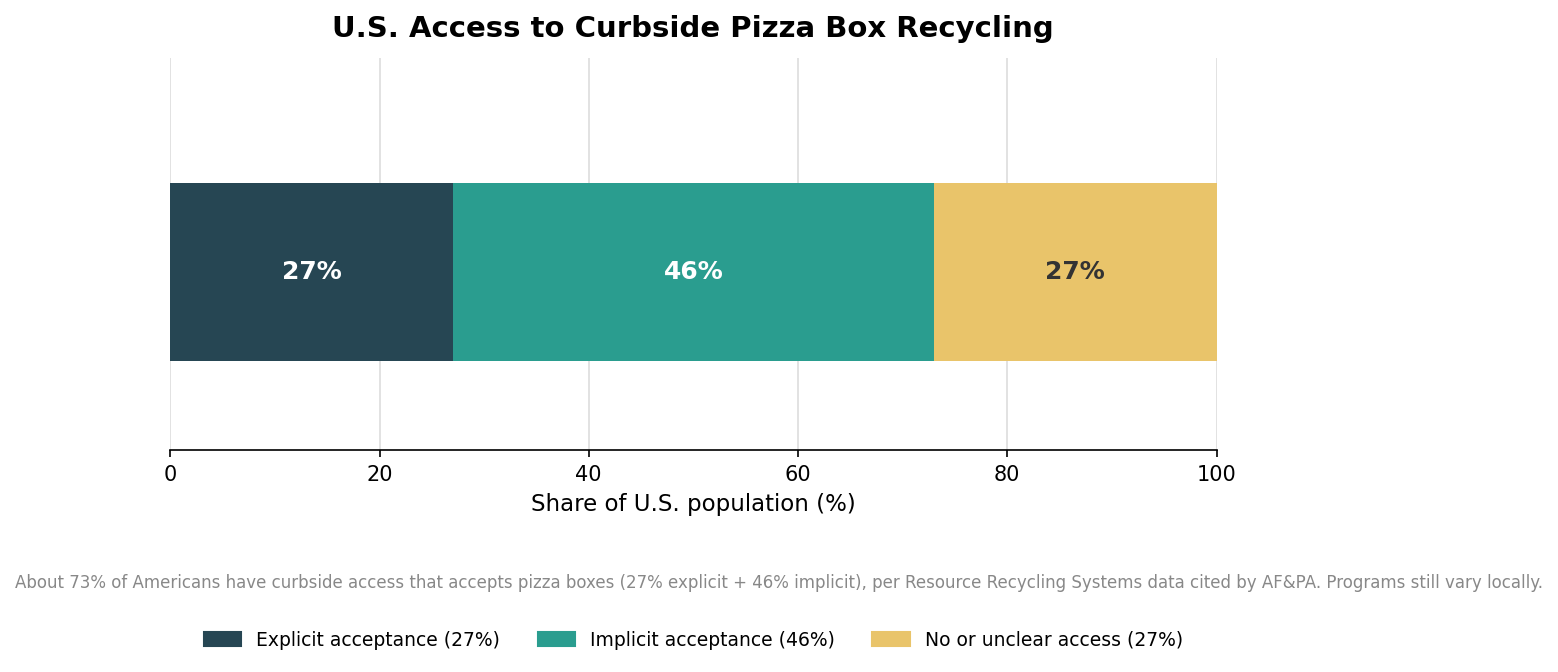
The technical verdict is settled, but your local hauler still gets the final say. Not every curbside program has updated its rules, so acceptance is uneven across the map. Industry data cited by AF&PA puts roughly 73 percent of the U.S. population within a program that accepts pizza boxes, split between about 27 percent whose program explicitly names them as accepted and about 46 percent where they fall under general acceptance of corrugated cardboard. The remaining quarter or so either excludes them or gives no clear guidance.
For a brand, the practical implication is that a blanket “100% recyclable” claim on the box can be misleading in the areas that still say no. A more defensible message points the customer to empty and check locally, which is both accurate and the behavior that keeps clean fiber flowing back to the mills.
About 73% of Americans have curbside access that accepts pizza boxes, but roughly a quarter still do not.
Recyclable and compostable are not the same thing
A plain corrugated box can be both recyclable and compostable, but coatings break that. Uncoated kraft or white corrugated is the friendliest case: clean sections recycle, and heavily soiled sections actually compost well because the grease that hurts nothing in pulping is just carbon to a compost pile. The complication is barrier coatings. A wax or plastic (polyethylene) laminate that some boxes use for grease and moisture resistance is generally not accepted in the paper recycling stream and is not compostable either, so a coated box can end up less recoverable than a plain one despite looking more premium.
If composting is the goal, the coating has to be certified for it. Compostable barrier treatments are tested against standards such as ASTM D6400 and ASTM D6868, and third-party marks like BPI certification signal that the whole box, coating included, will break down in a commercial composting facility. Without that certification, “eco” language on a coated box is not something you can stand behind. Where a figure or claim here is general rather than tied to a specific certified product, treat it as a starting point and confirm the certification on the exact board you buy.
PFAS is changing what the coating can be
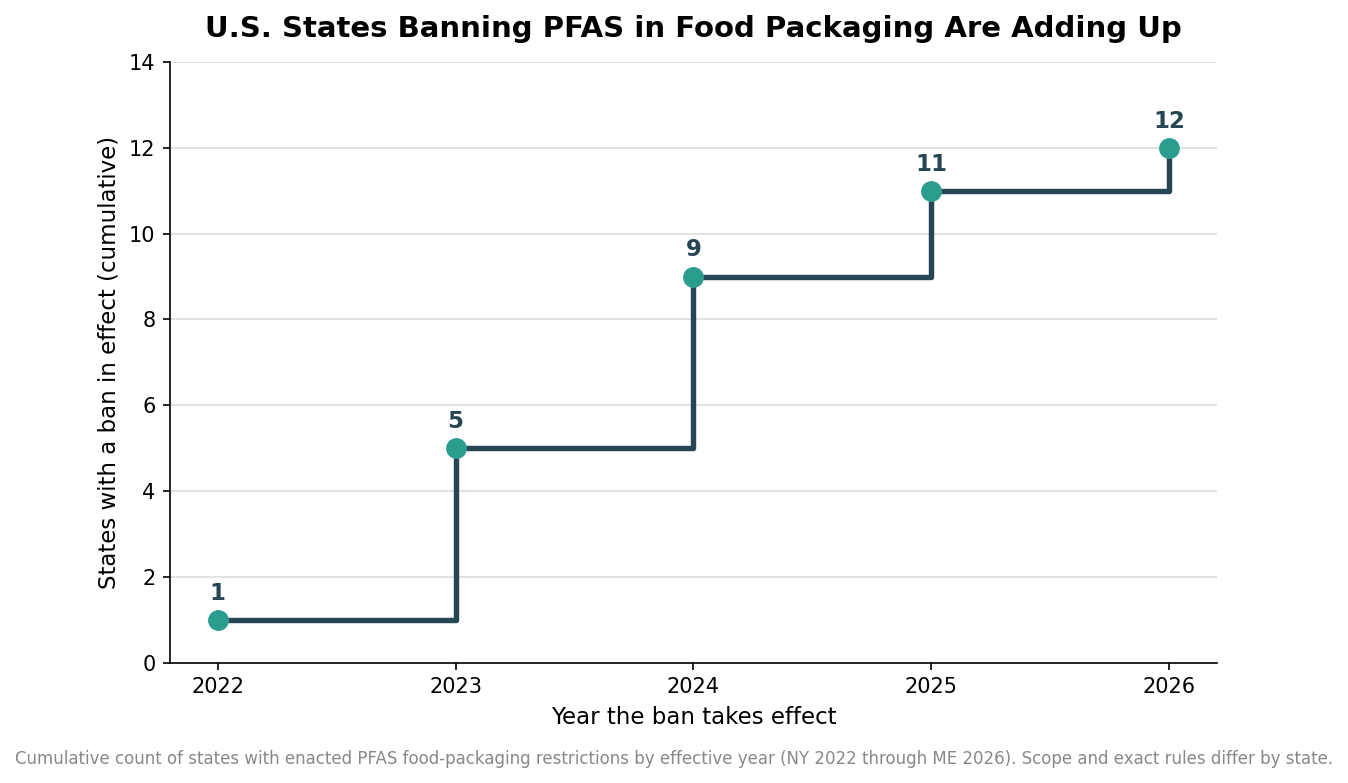
The grease resistance in many older food boxes came from PFAS, and that is now being banned. Per- and polyfluoroalkyl substances, the so-called forever chemicals, were a common way to make paperboard shrug off oil, and food packaging is one of the first uses regulators have moved against. A growing list of states has enacted PFAS restrictions on food packaging, beginning with New York at the end of 2022 and running through California, Washington, Vermont, Connecticut, and then Minnesota, Maryland, Colorado, Hawaii, Oregon and Rhode Island, with Maine’s plant-fiber packaging rule scheduled for 2026. That is roughly a dozen states with bans in effect or scheduled, and the direction of travel is clear.
For a buyer, this is a specification issue you cannot ignore if you ship into any of those states. The good news is that PFAS-free grease resistance is now widely available, using alternative treatments that keep oil out without the regulated chemistry. The action item is simply to ask your supplier to confirm the box is PFAS-free rather than assuming it, and to keep that confirmation on file as more states come online.
State PFAS food-packaging bans are stacking up, so PFAS-free grease resistance is becoming a compliance requirement.
What to spec, and what to print on the box
Put the disposal story and the compliance story into the spec at the same time. Favoring uncoated or recyclable-coated corrugated keeps the box in the recovery stream where most customers can actually recycle it; specifying PFAS-free grease resistance keeps it legal to sell as food packaging in the expanding list of states that require it; and choosing a certified compostable coating only when you genuinely want compostability avoids the trap of a coated box that is neither recyclable nor compostable. On the print side, decoration normally sits on the outside of the box with food-grade inks, so the food-contact surface stays clean, and boards with recycled content are routinely used for this indirect-contact role.
Finally, use the box itself to tell the customer what to do, because the recyclability gains are only real if people act on them. A short, honest line, empty the box and recycle the clean cardboard, check locally for greasy pieces, does more for your sustainability story than a broad claim the local program might not support.
Almost every decision that goes into a custom pizza box shows up on the quote: the size, the print method, the liner color, the coating. The one that rarely appears in plain language is the board grade, and it is the spec that quietly decides whether a box holds its heat, survives a long drive, and prints your logo sharp instead of soft. That board grade comes down to the flute, the wavy inner layer of the corrugation, and understanding it turns a vague conversation with a supplier into a specific one.
What a flute actually is
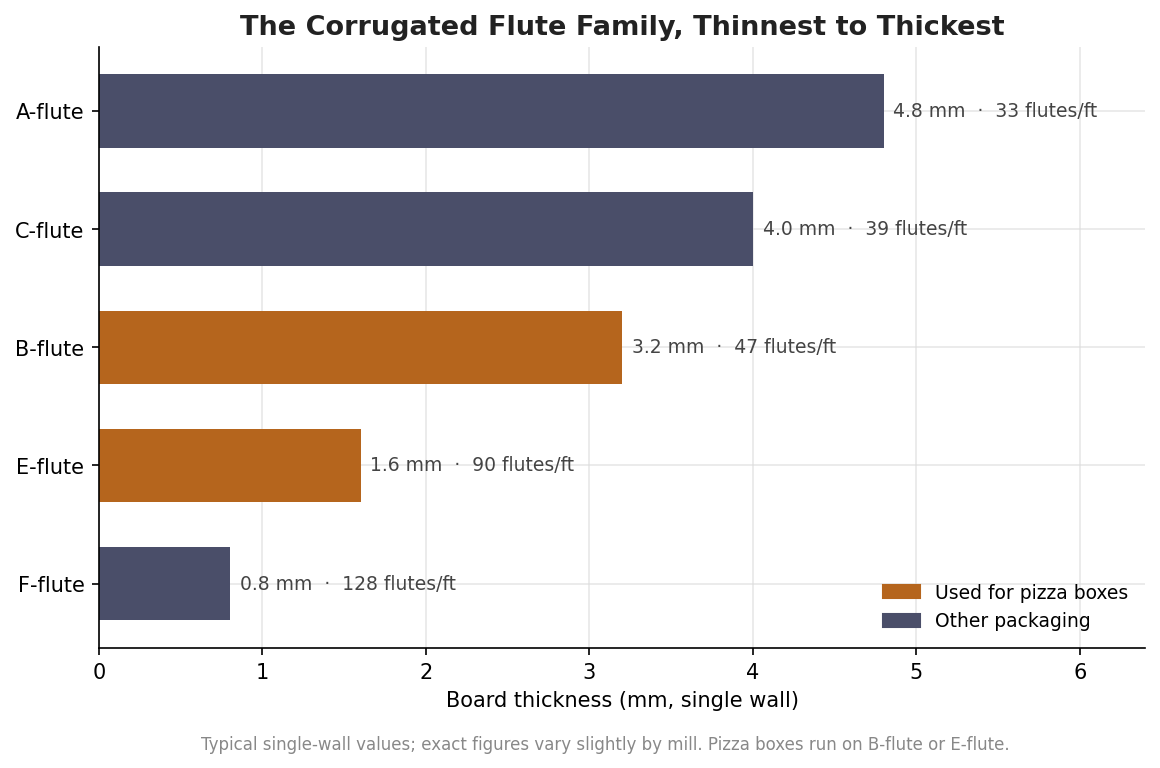
Corrugated board is three layers: a flat outer liner, a flat inner liner, and a fluted wave glued between them. That wave is the whole point. It gives the board stiffness far beyond its weight, traps a layer of air for insulation, and sets how smooth the printing surface is. Flutes come in a standard family labeled by letter, and the letters are not sized in the order you would guess. Ranked from thinnest to thickest, F and E flutes are the fine ones, B sits in the middle, and C and A are the tall, heavily cushioning grades used for shipping and fragile goods. The thinner the flute, the more waves are packed into every foot of board, which is exactly the trade-off that matters for food packaging. Almost every pizza box is single wall, meaning one fluted layer between two liners; the double-wall boards used for heavy freight are overkill for a pizza and would add cost and bulk without a payoff. So the whole decision narrows to which single-wall flute sits between your two liners.
The corrugated flute family by thickness; pizza boxes run on the mid B-flute or the fine E-flute.
Why pizza lives on B-flute and E-flute
Out of that whole family, pizza boxes are built almost entirely on two grades. B-flute, at roughly 3.2 millimeters, is the traditional pizza board, thick enough to give a large box real rigidity and a cushion of air under a hot pie. E-flute, at about 1.6 millimeters, is roughly half the thickness with nearly twice the flutes per foot, which gives it a much flatter, finer surface. The taller flutes of A and C would over-build a pizza box and waste material, while F-flute is too thin to carry a heavy pizza across town. Everything a pizzeria weighs, from print quality to heat retention to how the box holds up in a delivery bag, is really a choice between these two grades.
Thinner board, more flutes, and what you trade
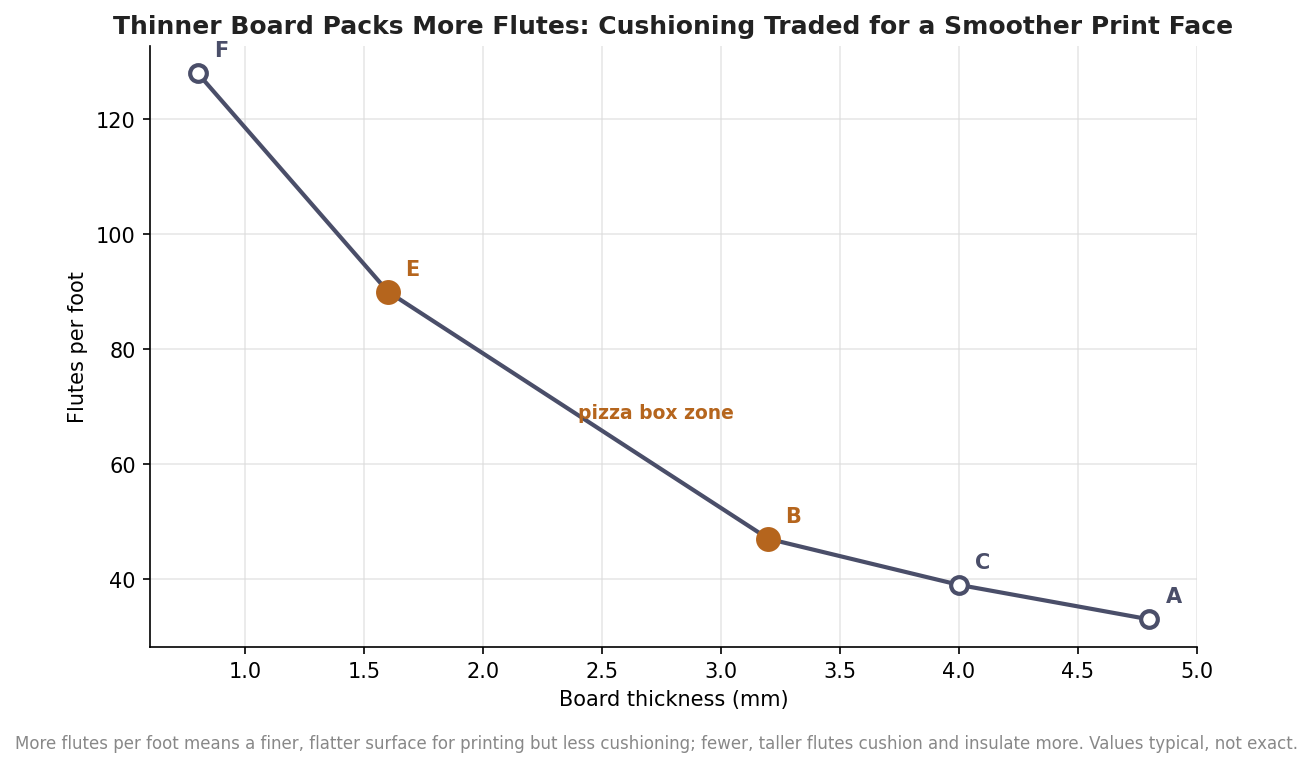
The relationship between the two numbers is the key to the decision, and it is close to a straight line. As the flute gets shorter, the count per foot climbs steeply, and the surface the printer works on gets flatter and finer. That is why E-flute carries detailed, full-color artwork better than B-flute: there are simply more, smaller ridges under the ink, so fine type and photographic images do not fall into the wash-boarding you sometimes see on a coarse box. The cost of that smoothness is cushioning and stiffness. Fewer, taller flutes trap more air and resist crushing better, which is what B-flute buys you. Neither is better in the abstract; they sit at two ends of the same trade-off.
As board gets thinner, flutes per foot climb, trading cushioning and insulation for a smoother printing surface.
Heat, grease, and the drive across town
For a food box, that trade-off translates into three practical behaviors. On insulation, the tighter cell structure of E-flute holds heat well and its flatter inner face can help manage the moisture that turns a crust soggy, while B-flute leans on its thicker air gap. On strength, B-flute is the safer choice for large pies and tall stacks in a warmer bag, because its taller flutes resist the crushing that flattens a box and smears the topping against the lid. On grease and moisture, the flute grade matters less than the liner and any coating, but a denser board simply has less open structure for oil to wick into over a long delivery. It is worth remembering that the flute works together with the liner: a clay-coated white liner gives ink a bright, smooth face and pairs naturally with the fine E-flute for premium print, while a kraft liner over B-flute reads as sturdier and more rustic. A short-run gourmet brand shipping a twelve-inch pizza a few blocks may favor E-flute for the print; a high-volume shop sending sixteen-inch pies across a metro area often stays on B-flute for the structure. Many suppliers stock both, so the honest first question is not which is better but which fits the way your boxes actually move.
Speccing board for your operation
The choice gets easier when you match the board to how the box actually travels. Start with your largest regular pizza size, because the bigger the box, the more the extra stiffness of B-flute earns its keep. Weigh your delivery profile next: long drives, stacked orders and hot bags reward structural board, while dine-in boxes, retail slices and pickup pies can lean thinner. Then decide how much your branding depends on fine print, because if the box is doing real marketing work with detailed artwork, E-flute’s smoother face may be worth the trade in cushioning. Ask your supplier to name the flute grade explicitly on the quote rather than accepting a generic corrugated, and request a plain sample of each candidate board so you can feel the difference before committing a full run. The board grade is a small line on the spec sheet, but it is the one that determines whether the box does its job from the oven to the doorstep.
Two pizzerias can order the exact same 14-inch box and end up with wildly different results, not because of the cardboard, but because of how the artwork was put onto it. The printing method behind a custom printed pizza box quietly decides three things that matter to every buyer: how many colors and how much detail you can show, how many boxes you have to order at once, and what each box costs. Pick the method that fits your artwork and your volume and everything lines up. Pick the wrong one and you either overpay for a short run or get stuck with a five-figure pallet of boxes you cannot use. Here is how the three common methods actually work and when each one wins.
Flexography: the workhorse for volume
Flexographic printing, or flexo, is what most people picture when they think of a printed pizza box. Raised images on flexible plates pick up ink from rollers and stamp it directly onto the board. It excels at bold, solid colors and clean text, and it typically runs one to four spot colors, which is plenty for a logo, a phone number, and a red-and-green Italian motif. What it does not do well is fine photographic detail or smooth gradients, because the process is built for punchy graphics rather than magazine imagery.
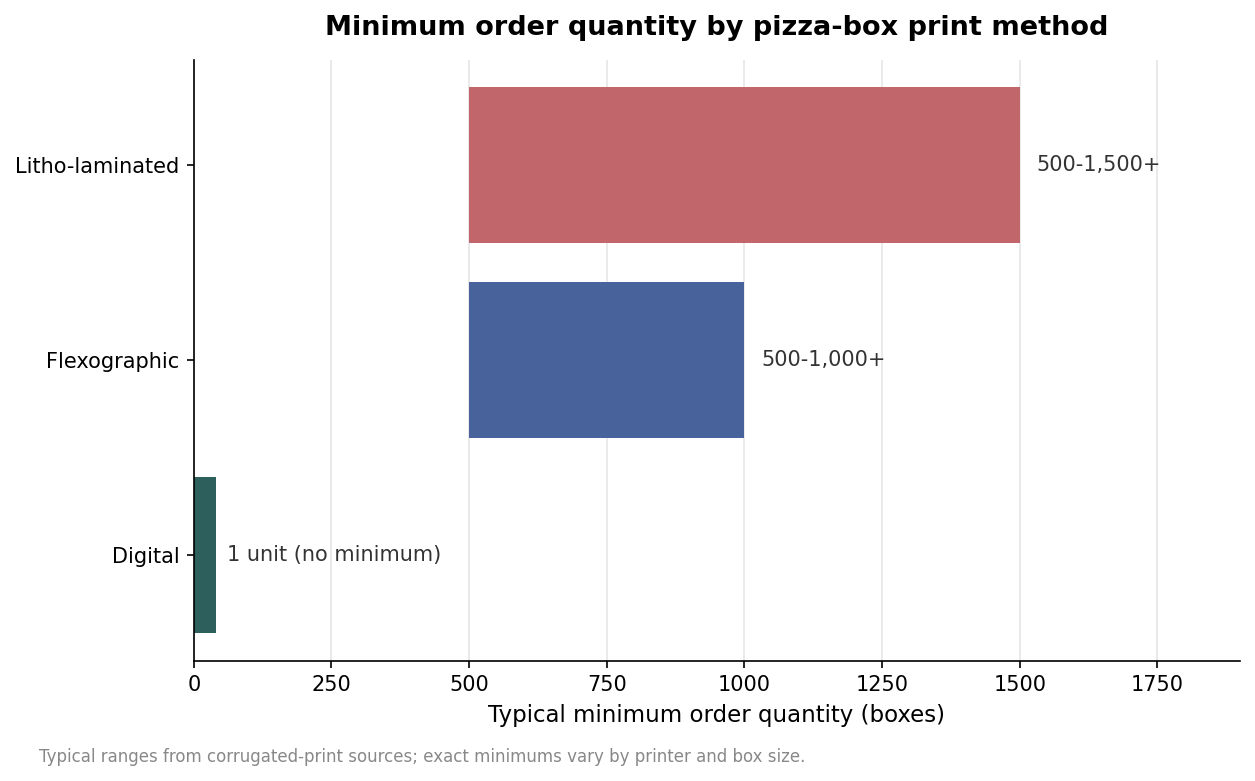
The economics are all about the plates. A set of flexo plates commonly costs somewhere between 200 and 800 dollars or more, and that expense is fixed no matter how many boxes you print. Spread across 500 boxes it stings; spread across 20,000 it disappears. That is why flexo carries a real minimum order, generally in the range of 500 to 1,000-plus boxes, and why it delivers the lowest per-box cost once you are ordering in serious volume. If you are an established pizzeria going through cases every week, flexo is almost always the right home.
Digital printing: full color with no minimum
Digital printing skips plates entirely. High-resolution printheads spray ink straight onto the board from your artwork file, the same way an office printer works, only at packaging scale. Because there is nothing to set up, there is no plate cost and effectively no minimum, and you can order a single box if you want one. It prints full CMYK, so photographs, gradients, fine text, and unlimited colors all reproduce cleanly, and you can even change the design box to box for a seasonal promotion or a limited run.
The trade-off is the per-unit price. Digital costs about the same to print the thousandth box as the first, so it never benefits from the plate-amortization curve that makes flexo cheap at scale. For a new pizzeria testing a design, a food truck running small batches, or a brand ordering a short seasonal edition, that flat cost is a feature. For a high-volume shop, it eventually becomes the expensive option.
Digital carries no real minimum; flexo and litho require several hundred boxes to start.
Litho-lamination: magazine quality for premium brands
Litho-lamination is the premium route. The artwork is printed on a flat paper sheet using an offset litho press, which produces the finest quality available, think magazine-grade color, crisp small type, metallic inks, and spot-gloss finishes. That printed sheet is then laminated onto the corrugated board so the box gets both the imagery and the structure. It supports full CMYK plus specialty finishes, which is why upscale frozen-pizza brands and retail-facing packaging lean on it.
All that quality comes at a price. Litho-lamination carries both plate costs and the added lamination step, so it is the most expensive per unit of the three, and minimums typically start around 500 to 1,500-plus boxes. You choose it when the box is part of the product experience and the shelf impression justifies the spend, not when you simply need a functional delivery container.
Matching the method to your quantity
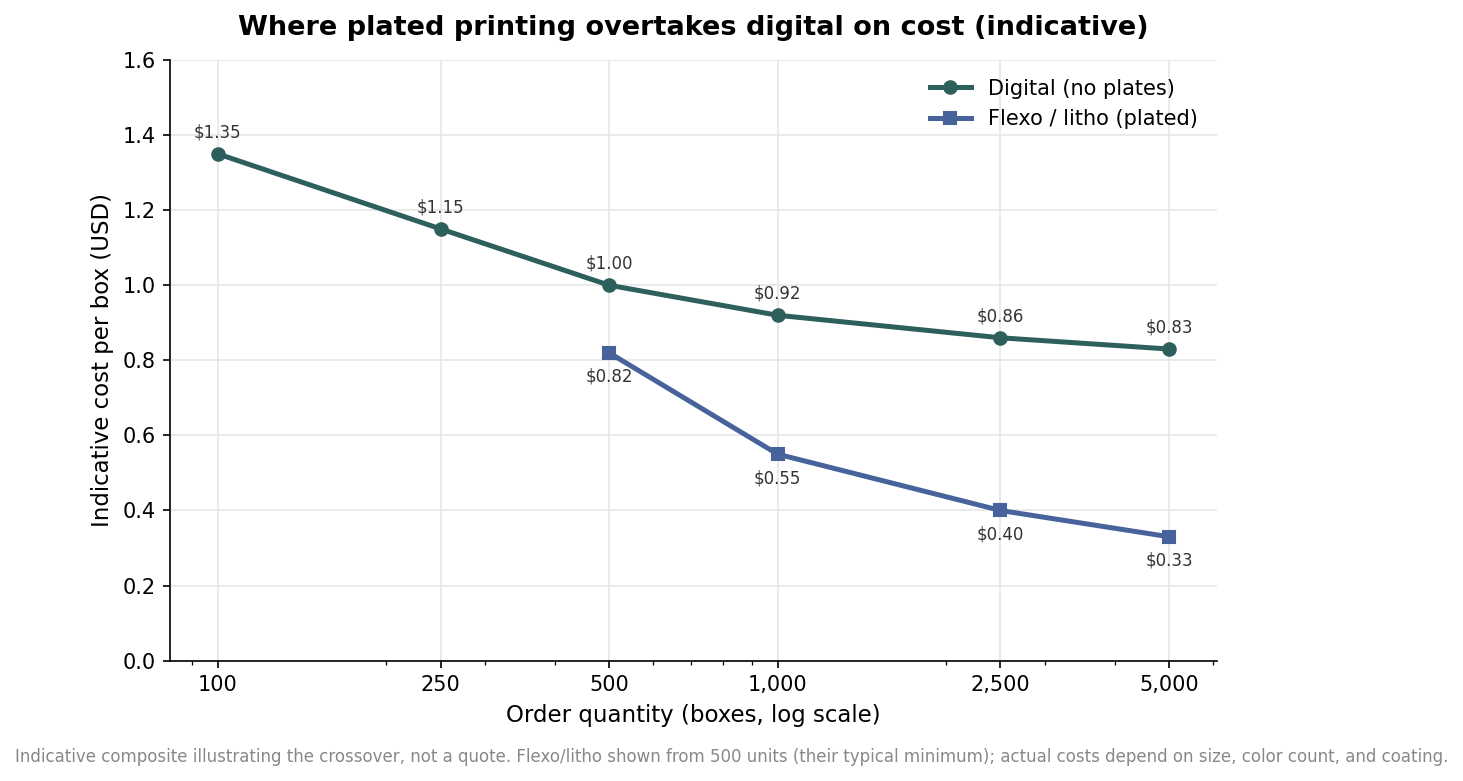
The decision usually comes down to volume, because the three methods trade places on cost as your order grows. At small quantities, digital wins on price because there is no setup to pay off. As the order climbs past roughly 500 to 1,000 boxes, the plate cost on a flexo run finally spreads thin enough that flexo drops below digital and keeps falling. The chart below sketches that crossover; the exact point moves with box size, color count, and coating, so treat the shape as the lesson rather than the specific numbers. The practical rule is simple: order short, print digital; order deep, print flexo; and reserve litho-lamination for when the finish itself is selling the product.
Digital is cheapest for short runs; plated printing overtakes it as volume grows (indicative).
Ink safety, board, and coating
Whatever method prints your box, the substrate underneath still matters. Pizza boxes are corrugated, most often a lighter B-flute or E-flute that balances stacking strength against a smooth enough surface to print on. The board comes as natural kraft or as a bleached, clay-coated white; kraft is cheaper and reads as rustic and eco-friendly, while a coated white face gives colors more pop and is the usual base for litho work, at a higher material cost. Because the box holds hot food, printers keep the artwork on the outside and use food-appropriate, typically water-based inks, so nothing problematic sits against the pie. Grease resistance is handled by the board and any coating rather than by the print itself.
Put the pieces together and the specification falls out naturally. Decide how much color and detail your design truly needs, be honest about how many boxes you will actually use in a buying cycle, and let those two answers point you to flexo, digital, or litho. Match the board and coating to the look you want, keep the inks food-safe, and the printed box will do its job on the counter and in the car without any expensive surprises.
How to Choose Custom Pizza Boxes for Your Brand: Use Cases and Ordering
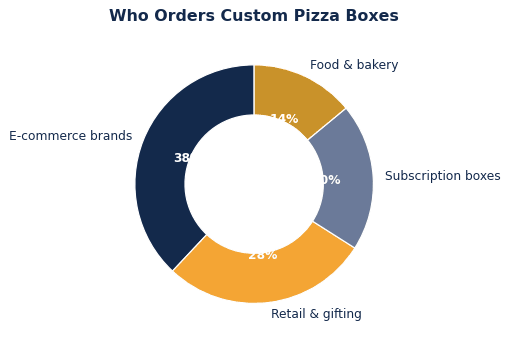
The best way to choose custom pizza boxes is to start from how they will be used, then work back to the material, size, and decoration that fit. Custom pizza boxes serve very different jobs across e-commerce brands, retail & gifting, subscription boxes, and food & bakery, and matching the order to the job is what makes custom pizza boxes feel purpose-built rather than generic. This guide maps the common use cases and walks through ordering custom pizza boxes that fit your brand.
Whether the pizza boxes protects a product, presents a gift, or carries a logo into the world, defining that job first keeps every later decision easy. Purpose drives the spec, and the spec drives the result.
How brands use custom pizza boxes
Custom pizza boxes get ordered for a mix of protection, presentation, and promotion, and knowing where yours fall points you to the right build. The breakdown below shows the common uses, from e-commerce brands to food & bakery.
The common ways brands put custom pizza boxes to work.
Most orders lean toward one primary job with a secondary benefit — a shipping-focused pizza boxes that also brands the unboxing, or a gift-focused one that also protects. Naming your primary use keeps the order focused and the spec appropriate.
Use case
What it needs
E-commerce brands
unboxing that photographs well and protects product
Retail & gifting
shelf-ready presentation and premium feel
Subscription boxes
repeat, on-brand packaging that builds loyalty
Food & bakery
food-safe board sized to the product
Matching material and size to the use
Once the use is clear, the material and size follow. A protection-first job favors a durable, well-fitted build; a presentation-first job favors a premium material and a clean print; a promotion-first job favors a cost-effective option you can order in volume. Sizing to the product with a small margin keeps the pizza boxes looking intentional and performing its job.
If a single order serves more than one use, spec to the most demanding one so the pizza boxes performs everywhere. It is easier to use a slightly sturdier or more premium pizza boxes across the board than to discover a bargain option falls short for your most important use case.
Branding for the impression you want
Decoration should reinforce the impression the use calls for. Flexo and litho printing handle bold and full-color art, while foil stamping, spot gloss, and embossing add premium finishes. For a premium or gift use, lean on finishes and restraint; for high-volume promotion, prioritize a bold, legible logo that reads at a glance and reproduces affordably at scale. Keep branding consistent with the rest of your packaging or merch so everything reads as one system.
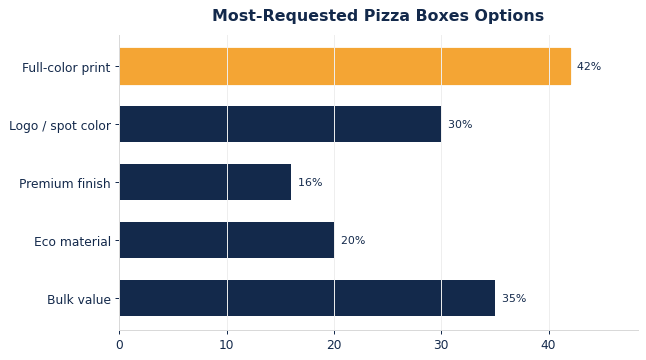
The most-requested options below reflect what buyers reach for most, and they are a useful starting menu when you brief your order. Whatever you choose, approve a proof so the finished custom pizza boxes match the impression you intended.
The options buyers request most on custom pizza boxes.
Getting the size and details right
Even with the use and material decided, the details are what make custom pizza boxes feel finished. Confirm the dimensions (length x width x depth) against the product with a small margin, check the print area for your chosen size so the logo sits cleanly, and decide on any finishing touches before you brief the order. These small confirmations up front are what separate a pizza boxes that looks intentional from one that looks close-enough.
A sample or proof is the cheapest insurance you can buy on a pizza boxes order. A physical sample lets you judge the material and print in hand, while a digital proof confirms artwork, color, and dimensions (length x width x depth) before the full run. Spending a few minutes here prevents the far larger cost of reworking a finished order of custom pizza boxes that missed on a detail.
Ordering: quantities, lead time, and reorders
A smooth pizza boxes order comes down to a few basics: order for real demand plus a small overage, send print-ready artwork early, and confirm lead time against any deadline so production and shipping fit your timeline. Per-unit cost drops with volume, so consolidating a season’s needs into one run is usually more efficient than repeated small orders.
Keep your approved artwork and spec on file so reorders are a quick repeat rather than a fresh setup each time — consistency across runs keeps your brand looking deliberate.
Coordinating with the rest of your brand
Custom pizza boxes rarely stand alone; they sit alongside your other packaging, print, or merch, so coordinating them strengthens the whole brand. Carrying the same logo, colors, and tone across your pizza boxes and your other pieces makes everything read as one deliberate system rather than a set of one-off orders. That consistency is what makes a brand feel established, and it costs nothing extra to plan.
Coordination also simplifies buying over time. Standardizing on a material, size, and decoration you are happy with turns future orders into simple repeats, and it keeps every batch matching the last. A little upfront alignment pays back every time you reorder custom pizza boxes.
Frequently asked questions about custom pizza boxes
What are custom pizza boxes used for?
Custom pizza boxes serve a mix of protection, presentation, and promotion across e-commerce brands, retail & gifting, subscription boxes, and food & bakery. Most orders lean toward one primary job with a secondary benefit, so naming your main use is the first step in speccing the right pizza boxes.
How do I match custom pizza boxes to my use?
Let the use drive the spec: durable and well-fitted for protection, premium and clean for presentation, cost-effective and bold for promotion. If one order serves several uses, spec to the most demanding one so the pizza boxes performs everywhere.
How should I brand custom pizza boxes?
Flexo and litho printing handle bold and full-color art, while foil stamping, spot gloss, and embossing add premium finishes. Choose finishes and restraint for premium or gift uses, and a bold, legible logo for high-volume promotion, keeping the branding consistent with your other packaging or merch so it all reads as one system.
How far ahead should I order custom pizza boxes?
Order for real demand plus a small overage, send print-ready artwork early, and confirm lead time against any deadline so production and shipping fit your timeline. Consolidating a season’s needs into one run is usually more efficient than repeated small orders.
Can I reorder easily?
Yes. Keeping your approved artwork and spec on file makes reorders a quick repeat rather than a fresh setup, and it keeps every batch of custom pizza boxes matching the last for a consistent brand look.
Do I need a sample before ordering custom pizza boxes?
A sample is worth it for a first order or a new material, since judging feel and print in hand removes the guesswork. For a straightforward reorder of custom pizza boxes you have bought before, a digital proof confirming artwork and dimensions (length x width x depth) is usually enough.
Match the pizza boxes to the job, spec it deliberately, and approve a proof, and your order will do exactly what you needed. For the full material and sizing breakdown, see our companion guide, our Custom Pizza Boxes: Materials, Sizing & Branding Guide, and browse our our shop to get started.
Not sure which custom pizza boxes fit your use?
Tell us how you’ll use them and we’ll match the material, size, and branding to the job.
Custom Pizza Boxes: A Materials, Sizing, and Branding Guide
Getting custom pizza boxes right comes down to three decisions: the material, the size or spec, and how you brand them. Make those well and you end up with custom pizza boxes that protect and present your product, reinforce your brand, and land on budget. This guide walks through the material options, how to size and spec your order, and how to decorate custom pizza boxes so they do real work for your brand rather than just checking a box.
Whether you are ordering your first run or reordering at scale, the same fundamentals apply. Choosing custom pizza boxes deliberately — material to job, size to product, decoration to brand — is what separates an order you are proud of from one you settle for.
Why custom pizza boxes matter for your brand
Custom pizza boxes are more than a commodity; they are a touchpoint brands experience directly. A well-chosen, well-branded option signals quality and attention to detail, while a generic one quietly undercuts an otherwise strong product. Because custom pizza boxes are seen and handled, they carry your brand into the world every time they are used.
That visibility is exactly why it pays to spec custom pizza boxes intentionally. The material sets the feel, the size sets the fit and cost, and the decoration sets the impression — and getting all three aligned turns a functional item into a genuine brand asset.
Materials and options compared
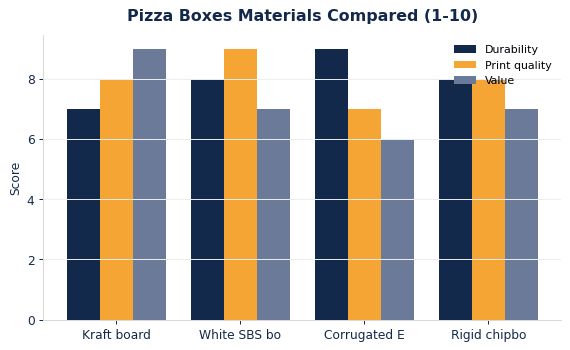
The common materials for custom pizza boxes each trade off durability, print quality, and cost: kraft board, white sbs board, corrugated e-flute, and rigid chipboard. The right pick depends on how the pizza boxes will be used, the look you want, and your budget. The chart and table below compare the main options so you can match material to job.
How common pizza boxes materials compare on durability, print quality, and value.
As a rule of thumb, choose a recyclable or natural material when eco positioning matters, a coated or laminated option when you want vivid full-color print, and a premium build when the pizza boxes is part of a gift or high-end presentation. When in doubt, request a sample so you can judge feel and print before committing to a full run.
Material / option
Best for
Kraft board
recyclable, natural look, great for eco brands
White SBS board
smooth surface for vivid full-color print
Corrugated E-flute
light protection with a printable surface
Rigid chipboard
premium, gift-worthy weight and feel
Sizing and specs
Sizing is where many pizza boxes orders go wrong, so measure before you order. Custom pizza boxes typically range from a small mailer at 6x4x2 in up to a large shipper at 12x9x4 in, and the right dimensions (length x width x depth) depends on the product or use they serve. Too small and the fit is tight or the product is exposed; too large and you pay for material you do not need and lose a clean, intentional look.
When a measurement falls between standard options, size to the product with a small margin rather than guessing. Confirming the dimensions (length x width x depth) on a proof or sample before a large run prevents the costly mistake of a full order that does not fit, which is far more expensive to fix than a five-minute check up front.
Branding and decoration
Decoration is what turns a plain pizza boxes into a branded one. Flexo and litho printing handle bold and full-color art, while foil stamping, spot gloss, and embossing add premium finishes. Match the method to your artwork and budget: simple logos reproduce cleanly and cheaply, while detailed, full-color designs shine with the right process on the right material. Keep the artwork vector where possible and confirm the print area for your chosen size.
Restraint usually reads as premium. A clean logo, one or two brand colors, and quality material almost always look more considered than a busy, over-printed design. Approving a proof before the run protects both the look and the budget, especially on a large order of custom pizza boxes.
Ordering and budget
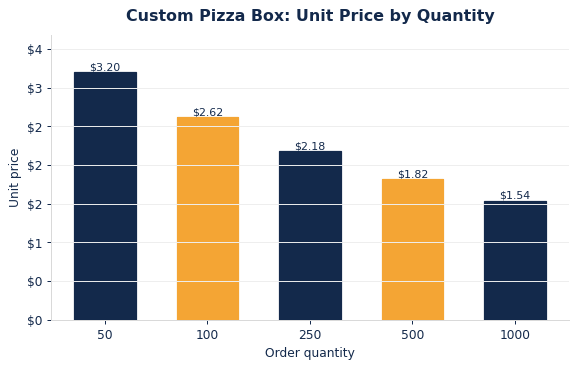
Per-unit cost on custom pizza boxes falls steadily with volume as setup amortizes across more pieces, so ordering for real demand rather than a token first batch is usually the efficient move. The curve below shows how pricing typically improves with quantity, which helps you plan an order that balances cash and cost.
Typical per-unit pizza boxes pricing as order quantity increases.
Ordering for a recurring need? A single larger run lowers the unit cost and keeps your branding consistent, while a small overage covers reorders and the occasional damaged piece without a rush order.
Common mistakes to avoid
A few avoidable missteps account for most disappointing pizza boxes orders. Ordering before measuring is the biggest, followed by choosing a material for price alone without considering how the pizza boxes will actually be used, and skipping the proof on a large run. Each is easy to prevent with a few minutes of planning, and each is expensive to fix once a full order is produced.
The other common trap is over-designing the artwork. Cramming in too many colors, effects, or details can muddy the print and raise the cost, especially on textured or recycled materials. Simplifying the design to a clean, legible mark almost always improves both the look and the price of your custom pizza boxes.
Frequently asked questions about custom pizza boxes
What material is best for custom pizza boxes?
It depends on the use: choose a recyclable or natural material for eco positioning, a coated or laminated option for vivid full-color print, and a premium build for gifting or high-end presentation. Request a sample to judge feel and print before a full run of custom pizza boxes.
How do I choose the right size?
Measure the product or use the pizza boxes serves, then size to it with a small margin so the fit is clean without wasting material. When a measurement falls between standard options, size up slightly and confirm the dimensions (length x width x depth) on a proof before ordering in volume.
How are custom pizza boxes branded?
Flexo and litho printing handle bold and full-color art, while foil stamping, spot gloss, and embossing add premium finishes. Match the method to your artwork and budget, keep the art vector where possible, confirm the print area for your size, and approve a proof so the finished custom pizza boxes match your intent.
How does pricing work, and is there a minimum?
Per-unit cost drops with quantity as setup amortizes across the run, so larger orders are more cost-effective. Order for real demand plus a small overage rather than a token batch, and consolidate recurring needs into one run for the best price.
Can I get a sample or proof before ordering?
Yes, and it is strongly recommended. A physical sample lets you judge material and print, and a digital or physical proof confirms your artwork, color, and dimensions (length x width x depth) before a full run — a small step that prevents a costly mistake on a large order.
What do you need to quote custom pizza boxes?
To quote accurately we need the dimensions (length x width x depth) or the product they serve, the quantity, your material preference, and your artwork or a description of the branding. With those details we can recommend the right material and size and give you pricing for the run, and a proof follows once the order is confirmed.
Whatever you order, send vector artwork, confirm material and dimensions (length x width x depth), and approve a proof before production. For help matching custom pizza boxes to a specific use, see our companion guide, our How to Choose Custom Pizza Boxes for Your Brand, and explore our our shop to start your order.
Ready to order custom pizza boxes?
Tell us your product, quantity, and branding and we’ll match the material, size, and decoration for you.
Home › Blog › A Pizzeria's Guide to Pizza Box Margins
Retail
A Pizzeria’s Guide to Pizza Box Margins
06/15/2026
Most independent pizzerias price a custom box as a straight cost against a plain, unprinted one, see the difference, and stop there. That comparison misses what a branded box actually does: it rides along on every single delivery and carryout order as free advertising, and it’s often the last thing a customer sees before they eat — and the first thing they photograph for social media.
Here is a simple way to think about the margin math before your next order.
The real per-unit gap
A blank pizza box typically costs a modest amount depending on size; a custom flexo-printed version at the same volume usually adds only a small premium once you’re ordering in the thousands. At 5,000 units, that premium often works out to a fraction of the cost of a single topping.
Where the return shows up
A branded box functions as a repeated brand impression that sits on a kitchen counter, a shared office table, or a coffee table for the length of the meal — something a plain box never earns back. It also reduces the risk of an order mix-up in a multi-restaurant delivery bag, since your name is printed on the box itself.
Order size
Relative cost*
12
Highest tier
2,000
Mid tier
5,000
Low tier
10,000+
Lowest tier
*Estimates only, illustrative of typical volume pricing — request a quote for your exact specs.
Setting your menu price
A simple rule of thumb: price the box as part of your cost of goods, not as a separate line item, and let the branding justify a small increase in your finished-pizza price rather than trying to recover it directly. Over a full production run, the packaging premium is almost always smaller than the perceived-value lift it buys, especially for delivery and ghost-kitchen orders where the box is the only physical brand touchpoint.
Key takeawayA custom pizza box typically adds only a few cents per unit at volume, and the branding keeps working as free marketing long after the order arrives.
Home › Blog › How to Order Custom Pizza Boxes: A Step-by-Step Checklist
Ordering
How to Order Custom Pizza Boxes: A Step-by-Step Checklist
05/27/2026
Ordering a first batch of custom pizza boxes is simpler than most first-time buyers expect, but a little prep before you request a quote makes the whole process faster. Here’s the checklist we walk every new account through.
1. Gather your artwork
Vector files (AI, EPS, SVG, or PDF) print the cleanest and let us scale your logo to any box size without quality loss. If you only have a PNG, JPG, or a photo of a sign, that’s fine too — our designers will recreate it print-ready at no charge.
2. Decide which sizes you need
Look at your actual order mix before choosing sizes. Most accounts standardize on the 12in Medium Pizza Box for the bulk of orders, then add a 10in Personal, 14in Large, 16in XL, or Corrugated Deep-Dish Box depending on menu offerings.
3. Pick a board finish
Kraft brown suits simple, 1–2 color logos and a rustic brand feel. White-coated board makes full-color graphics and photography-style logos pop. See our kraft vs. white-coated comparison if you’re unsure.
4. Estimate your quantity
Approximate is fine at the quote stage — we’ll firm it up once you see the mockup. Our minimum is just 12 boxes per size, and pricing improves meaningfully as quantity increases.
5. Confirm your timeline
Standard production is 2 weeks (faster turnaround available with express shipping) from approved mockup. If you have a hard launch date, a new location opening, or a seasonal event, flag it upfront — rush production may be available.
Step
What we need from you
1. Artwork
Vector file, or a photo/PNG we can recreate
2. Sizes
Which of our 5 sizes fit your menu
3. Finish
Kraft brown or white-coated
4. Quantity
Approximate is fine to start
5. Timeline
Any hard deadline for launch or event
Choosing for your order
Send us what you have on all five points, even if some answers are rough estimates. We’ll turn that into a photo-real mockup and bulk quote within one business day, and refine it with you at no charge until it’s exactly right.
Key takeawayGather artwork, sizes, finish, quantity, and timeline before you request a quote — it turns a multi-day back-and-forth into a same-day mockup.
Home › Blog › Grease-Resistant Pizza Boxes Explained
Durability
Grease-Resistant Pizza Boxes: What Actually Keeps a Box From Soaking Through
05/08/2026
Every pizzeria has seen it: a box that arrives with a translucent grease stain spreading across the bottom, or worse, a soggy patch that sticks the crust to the board. It’s the single most common complaint about cheap pizza packaging, and it comes down to a handful of specific construction choices — not luck.
Here’s what actually determines whether a box holds up.
Board weight and flute matter more than most people think
A thin, single-ply box has less material to absorb and redistribute grease before it reaches the surface. Our standard single-wall corrugated board is chosen specifically because the flute layer adds both structural rigidity and a buffer zone that slows grease penetration compared to flat, uncorrugated stock.
Coatings do the heavy lifting
The real grease-resistance work happens at the coating level. A food-safe grease-resistant coating on the interior surface of the board is what actually stops oil from wicking through to the outside, rather than the board material alone. This is a spec question worth asking about explicitly — not every “kraft box” on the market includes it.
Factor
Effect on grease resistance
Single-wall vs. double-wall
Double-wall adds buffer time before soak-through
Interior coating
Primary defense — slows or stops oil penetration
Box size vs. pie size
An undersized box concentrates grease in a smaller area
Time in transit
Longer delivery routes need more resistant board
Sizing the box correctly also matters
An undersized box crowds a pie against the walls and traps steam and oil in a smaller footprint, accelerating soak-through. Sizing your box correctly to your typical pie — and stepping up to a deep-dish or double-wall option for heavier, more heavily topped pies — does as much for grease performance as the coating itself.
Choosing for your order
For standard thin- and regular-crust pizzas, our single-wall board with a grease-resistant interior coating handles normal delivery times without issue. For deep-dish, heavily topped, or longer-transit orders, step up to our Corrugated Deep-Dish Box or ask about a double-wall upgrade on your standard size.
Key takeawayGrease resistance comes from the interior coating and correct box sizing more than the board color — ask specifically about coating when you order.