There are two strength questions buyers ask about a pizza box, and they are not the same question. One is how much a single box can hold, which matters when a loaded pie sits at the bottom of a delivery bag. The other is how much weight the box can carry stacked on top of it, which matters when a tower of flat stock sits in a back room or a bag holds three or four orders at once. People shop for the first number and then get surprised by the second. Understanding both, and the small formula that connects them, is what keeps a stack from pancaking on a Friday night.
ECT is the number on the box, and it means less than you think
ECT stands for edge crush test, and it measures how much force the board resists when pressed on its edge, reported in pounds per inch. It is the modern way corrugated is graded, and it is what most suppliers quote. Single-wall board runs across a familiar ladder of grades, and each grade carries a rough guide to how much weight a single box is rated to hold. The most common specification you will meet, by a wide margin, is 32 ECT, often paired with the older 200-pound Mullen burst rating. For a standard pizza box that is usually plenty, which is exactly why it is the default.
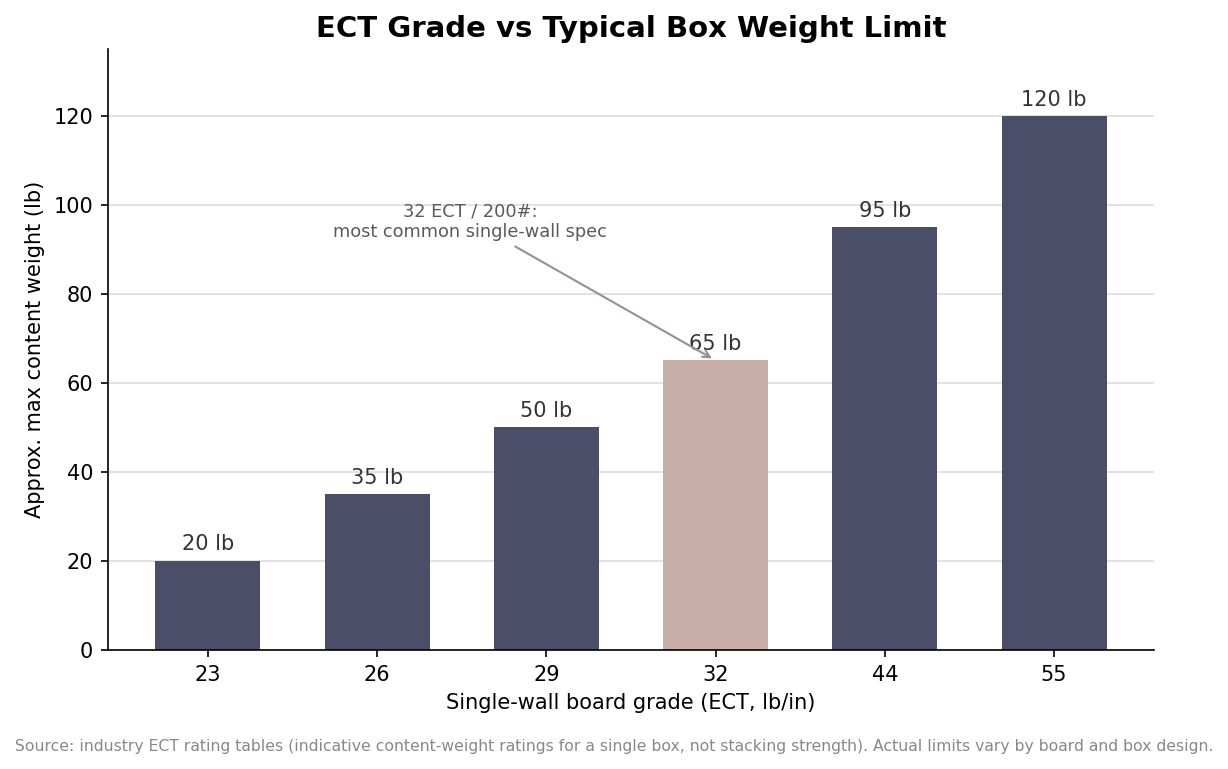
The important caveat is what that ladder does and does not tell you. Those figures are indicative content-weight ratings for one box sitting by itself, and they vary with board and box design. They are a useful sanity check when you are choosing a grade, but they say nothing directly about what happens when you stack boxes on top of each other. For that you need a different calculation, and it is the one that actually governs a storage room or a delivery bag.
Stacking strength is a different calculation
The load a box can bear from above before it buckles is its box compression strength, and you can estimate it from ECT with the McKee formula. The short version is BCT equals 5.87 times the ECT value, times the square root of the box perimeter multiplied by the board caliper, with everything in inches and pounds. Perimeter is just twice the length plus the width, and caliper is the board thickness. Run it for a typical 16-inch pizza box in 32 ECT B-flute, with a 64-inch perimeter and a caliper around an eighth of an inch, and you land near 530 pounds of estimated compression strength for the box as a whole.
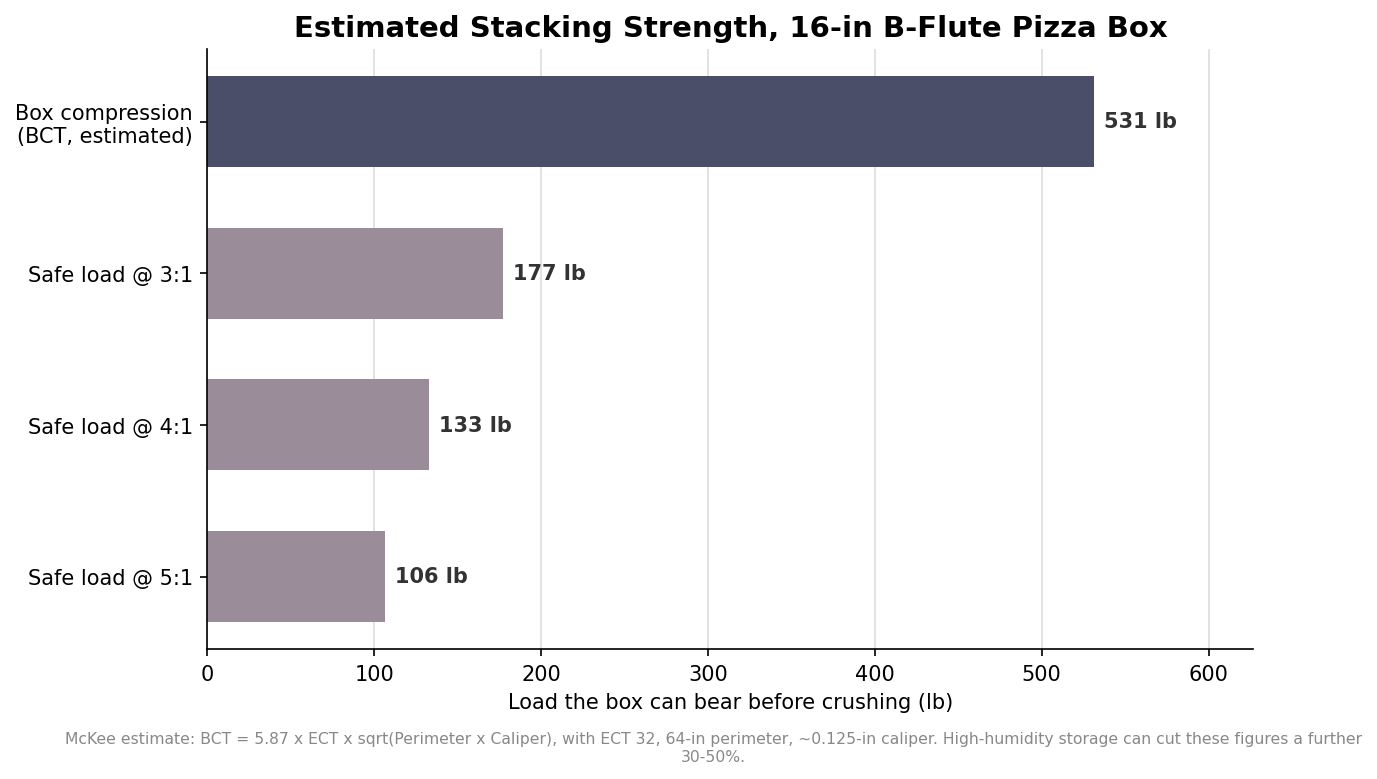
That number sounds enormous next to a two-pound pizza, and it is, but it is also the ceiling right before failure rather than a working limit. The formula also explains a detail that trips people up: a smaller, thicker box is stronger than a large, thin one made from identical board, because both perimeter and caliper feed the result. It is why a 16-inch box and a 20-inch box in the same grade do not carry the same load, and why upsizing a box without upgrading the board can quietly cost you strength.
Why you divide that number by three to five
Nobody loads a box to its breaking point, so engineers apply a safety factor, typically between three to one and five to one, to the compression figure. Divide that estimated 530-pound ceiling by three and you get a safe working load around 177 pounds; divide by five for long or rough storage and it drops to about 106. The heavier factors account for the fact that real life is not a laboratory. Boxes get handled, dropped, and stacked unevenly, and a static press test does not capture the jolt of a delivery bag hitting a car seat. The rule of thumb is simple: the longer boxes sit under load and the rougher the handling, the closer to five to one you should plan.
Humidity and time quietly steal the rest
Corrugated is paper, and paper gives up strength to moisture. Board stored in high-humidity conditions can lose 30 to 50 percent of its compression strength, which turns that comfortable safe load into a much thinner margin. A pizza kitchen is one of the more hostile environments for it: steam, wash-down areas, and boxes stored near a damp floor all pull the numbers down. Heat and grease from the pie itself soften the bottom of a loaded box the same way. This is the hidden reason a stack that looked solid at delivery time sags by the time it reaches the customer, and why the same box performs differently in a dry warehouse than in a humid back room.
The fixes are ordinary warehouse discipline. Keep flat stock off concrete on a pallet or shelf, away from exterior walls and dish areas, and rotate older stock so it is not absorbing moisture for months before use. Do not build flat-stock towers taller than they need to be, because the boxes at the bottom carry the whole column and are the first to crush once humidity has done its work. If your storage is genuinely damp, plan your grade as though you have already lost a third of the rated strength, because you probably have.
What this means when you spec and store
For most pizzerias, 32 ECT single-wall is the right starting point, and the strength conversation only becomes urgent when you stack tall or store in a humid space. If you regularly bag three or four loaded pies together, or keep deep towers of flat stock, it is worth asking your supplier for the BCT of the specific box rather than trusting the grade alone, and planning to a four-to-one or five-to-one safety factor with the humidity haircut on top. Flute choice plays into this too, but the practical levers are the grade you order, the size you order it in, and where you keep it. Get those three right and the box does its quiet job: holding the pie flat, holding its neighbors up, and never becoming the reason an order arrives crushed.
Leave a Reply