Most people shopping for pizza boxes start with a word: small, medium, large. The trouble is that those words mean different things from one supplier to the next, and a box ordered by adjective has a way of arriving too shallow for the crust or a half inch too wide for the pie. The reliable approach is to order by dimension. Once you know the outer footprint, the interior depth, and how much clearance the pizza actually needs, choosing a size stops being guesswork and becomes a two-number decision.
This guide lays out the standard sizes side by side, explains why depth is a separate choice from diameter, and covers the small tolerances that decide whether a pizza travels flat or arrives with the toppings shoved into one corner.
Order by the number, not by the name
A pizza box is described by a single nominal figure that matches the pizza diameter it is built to carry. A 16-inch box is sized for a 16-inch pizza, a 12-inch box for a 12-inch pizza, and so on. That figure refers to the outer footprint of the box, measured across one side. Because corrugated board has real thickness, the usable interior runs roughly a quarter inch smaller than the nominal size on each side, so a box labeled 16 inches gives you a little under 16 inches of clear floor. That is deliberate, and it matters more than it looks, as the clearance section below explains.
Regional naming is the reason to distrust adjectives. One shop’s large is another’s medium, and “family size” is not a measurement at all. When you specify a custom run, give the outer length, width, and height in inches. It removes ambiguity from the quote and from the artwork, since the printable panel dimensions follow directly from the box size.
The standard pizza box size chart
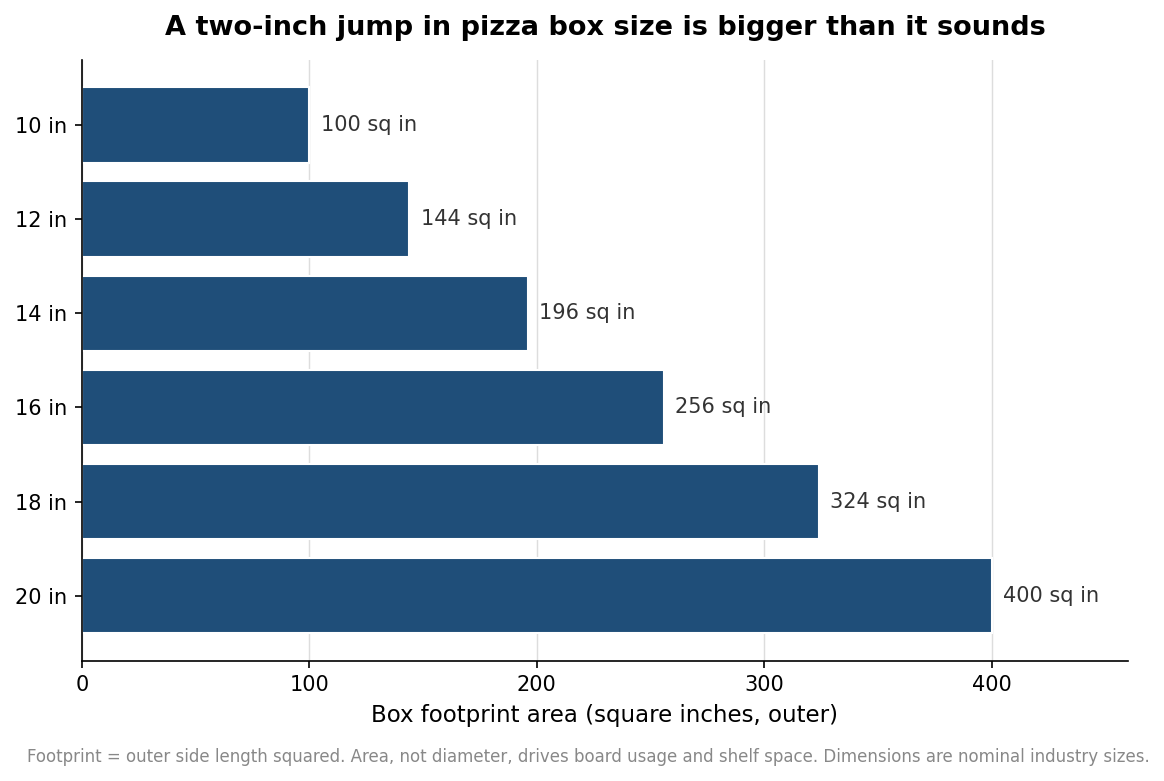
The sizes below are the common industry footprints. Personal boxes run about 7 by 7 inches or 9 by 10 inches for a single-serve or two-slice pie. The everyday retail range covers 10, 12, 14, 16, and 18 inches square, and extra-large formats reach 20 by 20 or 24 by 24 inches for party pies. A 10-inch box is typically around 10 by 10 by 1.5 inches, a 12-inch box about 12 by 12 by 1.75 inches, a 14-inch box 14 by 14 by 1.75 inches, and 16- and 18-inch boxes about 2 inches deep. Treat those heights as the default for standard crusts; deeper styles are covered next.
What the chart makes obvious is that the jump between sizes is not linear. Going from a 14-inch box to an 18-inch box sounds like a modest step, but the footprint area climbs from 196 square inches to 324, roughly a 65 percent increase in board per box. That is why a small change in your default size moves both your material cost and the shelf and delivery-bag space each box occupies.
Depth is a separate decision from diameter
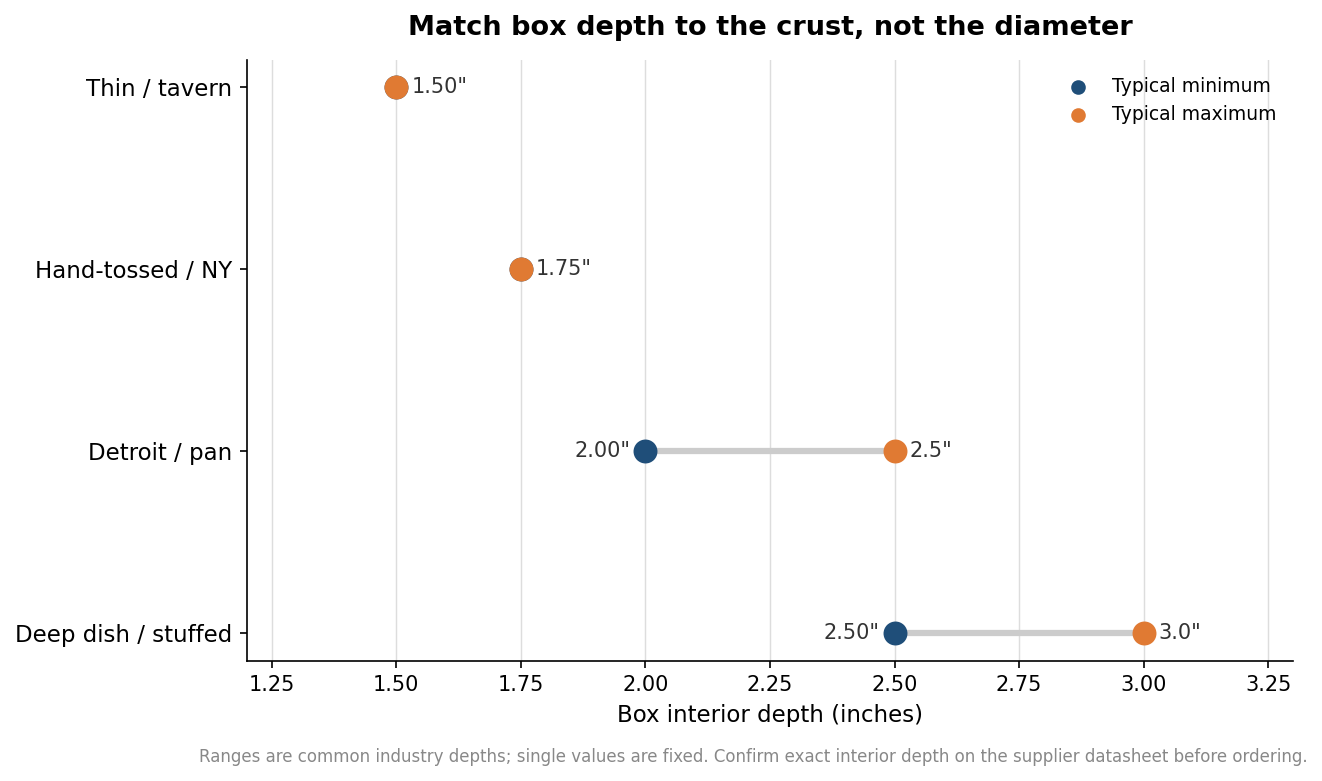
Diameter carries the pizza; depth keeps the lid off the cheese. The two are chosen independently, and depth follows the crust rather than the size of the pie. A thin or tavern-cut pizza sits comfortably in a box around 1.5 inches deep. Hand-tossed and New York styles are the everyday default at about 1.75 inches, which is why so many stock boxes ship at that height. Detroit and pan pizzas need more room, generally 2 to 2.5 inches, and deep dish or stuffed crust can call for 2.5 to 3 inches so the lid never rests on the toppings.
Get the depth wrong in either direction and it shows. Too shallow and the lid crushes the crown of the crust and drags cheese as it opens. Too deep and a thin pizza slides around under the extra headroom. If your menu spans several crust styles, it is common to standardize on one or two footprints and stock two depths rather than a separate box for every combination.
The quarter inch of clearance that keeps toppings in place
The small gap between the pizza and the interior walls is engineered, not accidental. With the interior sitting about a quarter inch under the nominal size, a correctly matched pizza has just enough room to be placed and removed without forcing the crust into the corners. Give it much more room and the pie can slide in transit, sending toppings to one edge and pressing cheese against the wall. Give it much less and the crust compresses into the corners and can buckle the side panel.
This is the practical case against sizing up “to be safe.” A 16-inch pizza belongs in a 16-inch box, not an 18-inch one. The extra footprint does not protect the pizza; it lets the pizza move. If you are unsure how a particular box fits a particular pie, ask the supplier for the interior floor dimensions rather than relying on the nominal label, since flute thickness varies slightly between board grades.
How to specify a custom size without a reprint
When you brief a custom run, lead with three numbers in order: length, width, and depth, all outer dimensions in inches. State the crust style you are packing so the supplier can sanity-check the depth against it. Confirm whether the quoted figure is the outer footprint or the interior floor, because a quarter-inch difference on each side changes both the fit and the usable print area. If your pies are cut to a house diameter that falls between standard sizes, say so early; it is far cheaper to adjust the tooling before printing than to discover the mismatch on the first pallet.
It also helps to think one step past the box. A box has to fit the delivery bag and the shelf it lives on, so a footprint that looks fine on paper can be awkward once it is stacked forty deep or slid into an insulated carrier. Checking the box against the bag and the storage space before committing to a size avoids the most common and most expensive sizing mistake, which is ordering a diameter that does not fit the rest of the operation.
Sizing a pizza box well comes down to two independent choices grounded in real numbers: the footprint that matches your pizza diameter, and the depth that matches your crust. Get those two right, respect the quarter inch of built-in clearance, and specify the box by dimension rather than by name, and the box will do its one job, which is to deliver the pizza looking exactly the way it left the oven.
Leave a Reply